
What Is an Equity Crowdfunding Portal? Founder Guide
The portal is the venue; the campaign is what helps investors understand the opportunity. An equity crowdfunding portal hosts a company’s offering and gives investors a place to review campaign information and participate. In equity crowdfunding, a company offers an ownership stake in exchange for investment.
Founders often focus on choosing a portal, but investor acquisition also depends on how clearly the company explains its business, risks, and growth plans. Effective equity crowdfunding investor acquisition starts with an audience that understands the opportunity and has a reason to learn more.
This guide explains how equity crowdfunding works, what a portal does, and how campaign marketing, audience appeal, and existing networks can shape a raise’s reach. It also covers why promotion must follow the offering rules and how founders can plan investor relations alongside the registered intermediary managing the raise. The aim is to clarify the process, not promise a funding outcome.
Key Takeaways
- Understand how an equity crowdfunding portal hosts an offering and how it differs from the issuer’s campaign marketing.
- Learn how clear company information can help potential investors assess whether an offering fits their interests.
- See why promotion must align with the offering’s rules, disclosures, and registered intermediary.
- Assess audience appeal by considering the company’s story, its existing networks, and the clarity of its campaign materials.
- Explore how consistent outreach and investor relations can support audience engagement without promising a fundraising outcome.
What Is Equity Crowdfunding?
An equity crowdfunding portal hosts an offering through which a company sells securities to investors. Investors review the campaign and decide whether to invest, potentially receiving an ownership interest in return. The portal provides the regulated setting for the transaction, while the issuer explains its business, risks, and offering.
A US Regulation Crowdfunding issuer may raise up to $5 million during a 12-month period, according to the U.S. Securities and Exchange Commission. Under Regulation A+ Tier 2 in the United States, companies can raise up to $75 million in a one-year period, according to the U.S. Securities and Exchange Commission. These are different offering pathways, with distinct filing and disclosure requirements.
Investor limits also shape participation. Under SEC Regulation Crowdfunding, a U.S. non-accredited investor whose annual income or net worth is below $124,000 may invest the greater of $2,500 or 5 percent of income or net worth during a 12-month period, according to the U.S. Securities and Exchange Commission. The campaign’s potential audience is therefore broad, but each investor’s permitted investment can depend on financial circumstances.
Equity crowdfunding investor acquisition is more than listing an offering. A company must communicate its business clearly, while investors assess the disclosures and decide whether to participate. Key risks include misunderstanding the security, overlooking disclosed risks, or assuming campaign attention guarantees investment. Common mistakes include vague claims and promotional materials that conflict with the offering disclosures.
Platform oversight matters. In the United States, an investment crowdfunding intermediary must be an SEC/FINRA-registered broker-dealer or a state-licensed funding portal. Founders can use this requirement as a starting point when comparing platforms, distinguishing a registered intermediary from a directory listing. A listing alone does not establish registration or suitability.
Investor verification and investment limits are related but distinct. Under Regulation Crowdfunding, the amount non-accredited investors may contribute depends on their annual income and net worth. The platform’s role, the investor’s information, and the offering’s eligibility terms all affect the process. Keep investor-facing materials consistent with the campaign information presented through the registered intermediary.
U.S. equity crowdfunding regulations are outlined in Title 17, Chapter II, Part 227 of the United States Code of Federal Regulations, according to the Office of the Federal Register, National Archives and Records Administration. That framework makes platform compliance and offering disclosures central to a campaign. Send legal questions about the offering structure or disclosures to qualified securities counsel.
Investors may cancel an equity crowdfunding investment for any reason until 48 hours before the deadline in the issuer’s offering materials, according to the U.S. Securities and Exchange Commission. Use deadlines, caps, and perks only when they are real and disclosed in your offering documents.
Equity crowdfunding campaign marketing and promotion
Campaign promotion connects the issuer’s offering information with people who may consider investing. Under Regulation Crowdfunding, marketing must also follow rules tied to when the issuer files Form C.
Campaign Accessibility and Community Engagement
Accessibility means making campaign information clear and available through channels where a company’s community can engage with it. Prospective investors need a straightforward path from discovering a company to reviewing its offering through the registered intermediary.
For example, an issuer can explain its product, customer problem, growth plans, and risks in plain language, then direct interested readers to its offering page. A founder might answer common business questions in public posts while keeping offering details consistent with official materials. Community engagement should inform people, not imply that participation or investment is expected.
Campaign materials can explain how shares or other securities relate to the company’s plans. This context helps audiences distinguish an equity offering from venture capital or a product presale. Keep updates accurate, and direct readers to the registered intermediary to review and participate in the offering.
Campaign Advertising and Marketing Rules
Campaign advertising rules govern what an issuer may communicate, where it may communicate, and how offering details are presented. Public messages can become part of the offering’s compliance record.
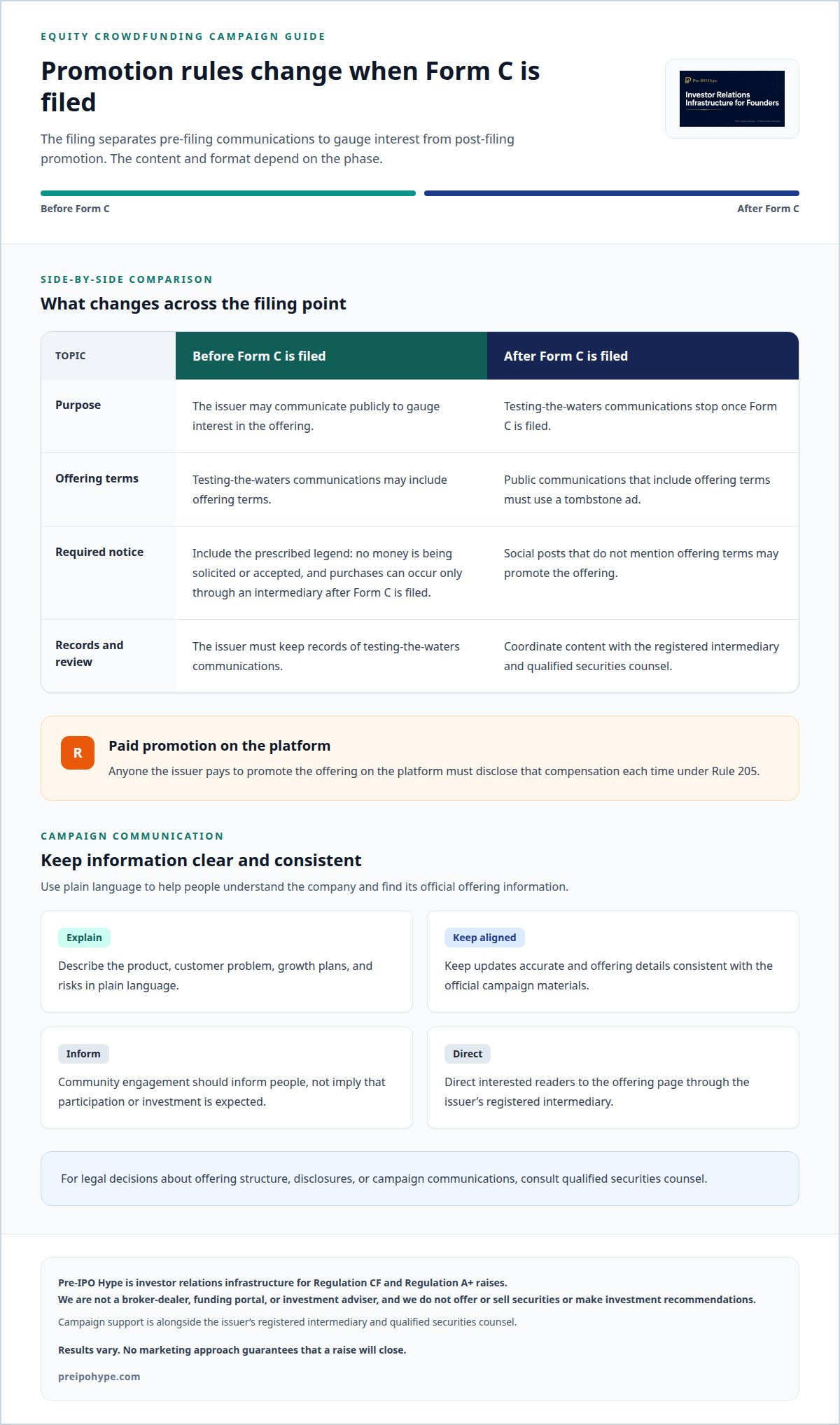
Before filing Form C, an issuer may communicate publicly to gauge interest, including by sharing offering terms. These testing-the-waters communications must include the prescribed legend stating that no money is being solicited or accepted and that purchases can occur only through an intermediary after Form C is filed. The issuer must keep records of these communications.
Once Form C is filed, testing-the-waters communications stop. Social posts that don’t mention offering terms may promote the offering, while public communications that include terms must use a tombstone ad. The issuer should coordinate content with its registered intermediary and qualified securities counsel. Anyone the issuer pays to promote the offering on the platform must disclose that compensation each time under Rule 205.
Campaign materials include the company’s explanation of its business, its disclosures, and the channels used to share them. A clear sequence helps: introduce the company’s purpose, explain its growth strategy, answer recurring questions, and direct readers to the offering page for full materials. Keep the language consistent across emails, social posts, and campaign updates.
Track campaign momentum by observing questions, page visits, and investor engagement, rather than treating attention as a promise of investment. A quiet response may indicate that the audience needs clearer information or different distribution. An active community can extend awareness, but engagement should remain factual and never exaggerate demand.
For founders shaping this work, a conversation about equity crowdfunding campaign planning can help clarify messaging and channel choices.
Assessing audience appeal and marketing networks
Audience appeal depends on the fit between a company’s offering and the people it can reach. Assess that fit by examining customer interest, evidence of demand, and the channels available to carry accurate information.
Investor Acquisition Channels
Channels are the routes an issuer uses to share its campaign with potential investors. The right mix depends on where relevant audiences already engage, so equity crowdfunding investor acquisition often starts with existing customer, employee, and founder communities.
For example, a startup can share a plain-language company update through its email newsletter, then use social posts to direct interested readers to its offering page. Industry groups and founder networks can extend the conversation when the message suits their members. No single channel fits every company, so compare engagement and follow-up questions across channels.
Investor Targeting Strategies
Investor targeting means prioritizing outreach to audiences with a clear reason to understand the company and its offering. A focused message can explain why the company’s product, market, or growth plan may interest a particular community.
A startup selling tools to independent retailers, for example, could tailor an educational update to that business community. The issuer should distinguish customer interest from investment interest: buying a product and evaluating securities are different decisions. Describe the audience factually, and direct investors to the registered intermediary for offering information.
Assess appeal through evidence, not promotional language. A founding team can review customer feedback, repeat use, sales activity, and the problem its product addresses. For instance, a software startup might explain how customer interviews shaped a feature, then show how it relates to the company’s market strategy. These details help readers evaluate the business without implying investment outcomes.
Market statistics can provide context, but they do not establish demand for an individual offering. A broad crowdfunding figure says little about whether a particular company’s audience understands its product or is interested in its securities. Connect market claims to the company’s own evidence, identify the source, and distinguish market size from actual customer traction.
Marketing networks are most useful when they foster informed conversations. Map existing relationships by relevance, such as customers, suppliers, industry associations, and professional communities. Then tailor content to each audience: a product explainer for customers, a business overview for industry peers, and a clear route to the registered intermediary for people reviewing the offering.
Secondary-market access also affects how investors assess an offering. Securities sold through equity crowdfunding generally cannot be resold within 12 months of the initial purchase except in limited circumstances, according to the U.S. Securities and Exchange Commission. Early exits therefore shouldn’t be treated as a campaign promise. Founders should explain liquidity risks accurately and have qualified securities counsel review legal disclosures.
Investor acquisition and audience reach
Investor acquisition combines audience planning with a clear path from first contact to offering information. The practical task for an issuer is to make communications relevant, consistent, and easy to evaluate.
Acquisition Across Platforms and Campaign Types
Acquisition approaches vary with each platform’s investor experience and the issuer’s campaign format. A message suited to one audience may not explain another company’s opportunity clearly.
Founders can compare platforms by reviewing how investors discover offerings, what campaign materials appear, and where questions are handled. A company with a consumer-facing mission may explain its product, while a specialized business may clarify its market problem and operating model. Match outreach to the actual audience and direct readers to the registered intermediary.
Keep platform discovery separate from the issuer’s own outreach. A platform listing can help investors find an offering, while issuer communications provide context about the company. Coordinating both helps prevent conflicting descriptions and gives readers a consistent route to official information.
Investor Acquisition Costs
Acquisition costs include the resources used to plan, create, distribute, and assess campaign communications. Understanding these components helps founders allocate staff time and promotional spending across channels.
For example, an issuer can record staff hours for content creation and follow-up alongside expenses for creative production or advertising. Compare these inputs with meaningful engagement, such as relevant questions and visits to the offering page. There is no universal cost per investor, since campaign scope, audience, and channel mix differ.
Review performance by channel instead of combining every activity into one total. If a campaign email prompts detailed questions but a social post draws broad, brief attention, those responses have different planning value. Use the distinction to decide where to focus the next communication effort.
Building a Prelaunch Investor Pipeline
A prelaunch pipeline organizes prospective audience relationships and communications before a campaign opens. It lets founders prepare useful information and plan follow-up without treating early interest as an investment commitment.
Group contacts by their relationship to the business, then note what information each group may need. Customers may want product context; suppliers may understand the operating model; industry peers may ask about market positioning. Prepare relevant updates and keep contact records organized. Direct investment questions to the issuer’s registered intermediary.
Before launch, check that the company’s core explanation is consistent across its materials. The team can practice answering questions about its mission, operations, and risks, then identify gaps that need clearer communication. This preparation gives the issuer a workable process for tracking engagement and responding accurately as the campaign develops.
Pre-IPO Hype: Custom Investor CRM
Pre-IPO Hype provides investor relations infrastructure for Regulation CF and Regulation A+ raises. It is not a broker-dealer, funding portal, or investment adviser, and does not offer or sell securities or make investment recommendations.
Founders preparing campaign communications and investor follow-up can use Pre-IPO Hype’s campaign support alongside the issuer’s registered intermediary and qualified securities counsel. Its Investor Relations and Marketing Campaigns and Custom Investor CRM support the campaign workflow, with the CRM providing lead scoring and attribution tracking.
Qualified securities counsel should address legal decisions, while the registered intermediary handles the offering process. Results vary, and no marketing approach guarantees that a raise will close.
Contact Pre-IPO Hype to discuss campaign support for your raise.
Make your next campaign decision with clarity
A thoughtful approach to equity crowdfunding investor acquisition starts with a clear operating plan: what the company will explain, which audiences need that information, and how interested readers can reach the official offering materials. Set these priorities before choosing campaign channels. They give the team a practical basis for coordinating communications, assessing engagement, and adjusting the plan as the campaign develops.
Keep the next step focused. Identify the questions your audience needs answered, align campaign messages with the issuer’s disclosures, and coordinate campaign support with the registered intermediary. Qualified securities counsel should guide legal decisions. This connects audience outreach to the offering process without confusing marketing activity with investment recommendations.
If you’re preparing a Regulation CF or Regulation A+ campaign, a focused discussion can help you consider how marketing support fits your plans.
Build the campaign around accurate information and thoughtful communication, then move forward one well-considered decision at a time.
Frequently Asked Questions
What is investor acquisition in equity crowdfunding?
Investor acquisition is the process of reaching people who may want to review an issuer’s offering. It involves planning communications, sharing relevant company information, and directing interested readers to the proper offering channel. For example, a founder could explain a product update to customers, then direct anyone seeking investment details to the issuer’s registered intermediary. Keep audience engagement distinct from completed investment commitments.
What are typical conversion rates and acquisition benchmarks for equity crowdfunding campaigns?
No single conversion benchmark applies to every campaign. Issuers can measure distinct steps, including email responses, offering-page visits, questions from potential investors, and completed participation through the intermediary. Reviewing these stages separately helps identify where communication may need improvement. A click or sign-up is not an investment commitment, so do not treat early engagement as evidence of a particular campaign outcome.
How do Regulation Crowdfunding and Regulation A+ rules affect investor outreach and advertising in the United States?
Outreach requirements depend on the offering pathway, timing, and content of each communication. Under Regulation Crowdfunding, issuers should distinguish communications made before Form C from those made after filing, because the rules for promoting an offering differ. Regulation A+ has its own requirements. Coordinate campaign materials with the registered intermediary, and have qualified securities counsel review legal questions and communications before publication.
How do equity crowdfunding platforms help issuers acquire investors, and what fees do they charge?
A registered intermediary provides the platform where investors can review and participate in an offering. Platforms may differ in investor experience, campaign tools, and commercial arrangements. Before choosing one, compare the services in its agreement and how charges are structured, then consider whether its offering process fits the issuer’s communication plan. Consult qualified securities counsel about legal questions related to platform arrangements.
How can issuers use email, social media, PR, and paid ads to attract crowdfunding investors?
Email can deliver detailed updates to people who have opted to hear from the company, while social media can share timely business information. Public relations can explain the company’s work to relevant audiences, and paid advertising can extend message distribution. Keep claims accurate and consistent with offering materials. Direct investment questions to the issuer’s registered intermediary, and consult qualified securities counsel about advertising requirements.
Disclaimer
Educational only. Not investment, tax, or legal advice. Pre-IPO Hype is investor relations infrastructure for Regulation CF and Regulation A+ raises. We are not a broker-dealer, funding portal, or investment adviser, and we do not offer or sell securities or make investment recommendations. Any securities offering is made only by the issuer, through its own offering documents and, where required, a registered intermediary.