
What Is a Rolling Close in Fundraising? Founder Guide
A rolling close lets a company keep a fundraising round open to additional investors after an initial closing, if the offering documents permit further closings. To understand what a rolling close in fundraising means, start with its defining feature: initial investors can close while later investors join under the offering’s terms.
That flexibility can let a company continue accepting investments, but it brings trade-offs. Each later closing can add administrative work, and new investors may seek rights or accept obligations that differ from those of initial investors. The offering documents may also limit the amount raised or the time available for further closings.
This guide explains how later investors join, what to consider before the initial close, and when a rolling close may not suit a round. Results vary. No marketing approach guarantees that a raise will close.
Key Takeaways
- Set out in the offering documents whether later investors can join, who may participate, and any limits on further closings.
- Plan how later investors’ rights and obligations will align with the terms accepted by initial investors.
- Account for the paperwork and company-record updates that each additional closing can require.
- Assess whether a rolling close fits the round, especially if investors are waiting for a lead investor or a defined closing point.
- Bring qualified securities counsel into decisions about offering documents and closing terms.
Further closings for specific or unidentified investors
A rolling close may reserve later closings for named investors or allow additional equity investment more broadly. The company may not yet know which investors will participate. The flexibility is useful only if the offering documents explain who can join and how the process works.
For a U.S. raise, the applicable securities framework depends on the offering type and its documents. A rolling-close schedule does not replace those requirements. Founders should have qualified securities counsel review how each closing fits the offering, subscription documents, and investor communications. The rules therefore depend on the structure of the raise, not on the label “rolling close.”
The offering documents and registered intermediary’s procedures govern how funds are handled between closing dates. They should clarify whether accepted funds remain held until stated conditions are met or can be released after a closing. Before accepting subscriptions, align the closing schedule, fund handling, and investor communications rather than assuming everyone’s funds move on the same date.
Tell investors that the initial closing does not necessarily end the round. Disclosures should explain whether additional closings may occur, how later investors can participate, and any relevant limits or timing conditions. They should also describe how later investors’ rights and obligations relate to those of initial investors. Qualified securities counsel can review the disclosures against the offering documents.
A later investor may seek rights or accept obligations that initial investors did not. For example, a new subscriber might request a separate information right. The company must assess whether that request fits existing agreements or requires amendments and investor signatures. A rolling close may also cap further investment, helping control the round’s total size.
Define the process before the first closing: state whether later investors are named or may come from a broader network, explain how subscriptions are reviewed, and describe the closing conditions. Set out how any cap or end date works in the offering materials. Use deadlines, caps, and perks only when they are real and disclosed in your offering documents.
New investors in a rolling close generally must adhere to the relevant shareholders’ agreement. Authority to issue new shares is usually required; obtaining it for later closings alongside the first can help avoid delays. If funding is urgent but lead-investor sign-off is unavailable, an advance subscription agreement or convertible loan note may serve as an interim solution. Changing executed investment documents can require some or all investors’ signatures, and investors may resist changes to agreed terms.
Keeping a fundraising open after an initial closing
A single final close gives the round one planned endpoint. With a rolling close, the company completes an initial closing and can then accept further equity investment through later closings. This gives the company more time to consider additional subscriptions, but keeps the funding process active after the first group has invested.
The subscription agreement for the initial closing should permit further closings. Without that provision, the company may need to amend executed documents, potentially requiring signatures from some or all investors. Investors may resist changes to terms they have already accepted. Qualified securities counsel can review whether the closing structure fits the company’s documents.
Later closings can occur at the same or a higher price, which may help protect initial investors from dilution in the value of their shareholding. The documents can also set a time limit so the mechanism does not remain open indefinitely. New investors generally agree to the relevant shareholders’ agreement, linking their obligations to the existing investor framework.
How does this differ from a single final close? With one final close, investors complete their subscriptions at the planned endpoint. A rolling close permits later closings after the initial one, subject to the documents and closing conditions. The structure determines how long the round stays open and how each investor’s subscription is accepted.
Deadlines, minimums, and commitments depend on the offering documents, not on the phrase “rolling close.” The documents should state whether a closing deadline or minimum subscription applies and when an investor’s commitment becomes effective. A clear record of each accepted subscription distinguishes an expression of interest from an executed commitment. Do not describe a deadline or minimum that the offering documents do not establish. Use deadlines, caps, and perks only when they are real and disclosed in your offering documents.
A rolling close usually requires shareholder authority to issue new shares. Obtaining that authority for later closings alongside the first can help avoid delays. The company should also plan how each closing will affect ownership records and investor communications. If investors are reluctant to close before a lead investor, keeping the round open may not solve the timing problem. The company could end up managing an open process without the expected participation.
How does a rolling close work step by step?
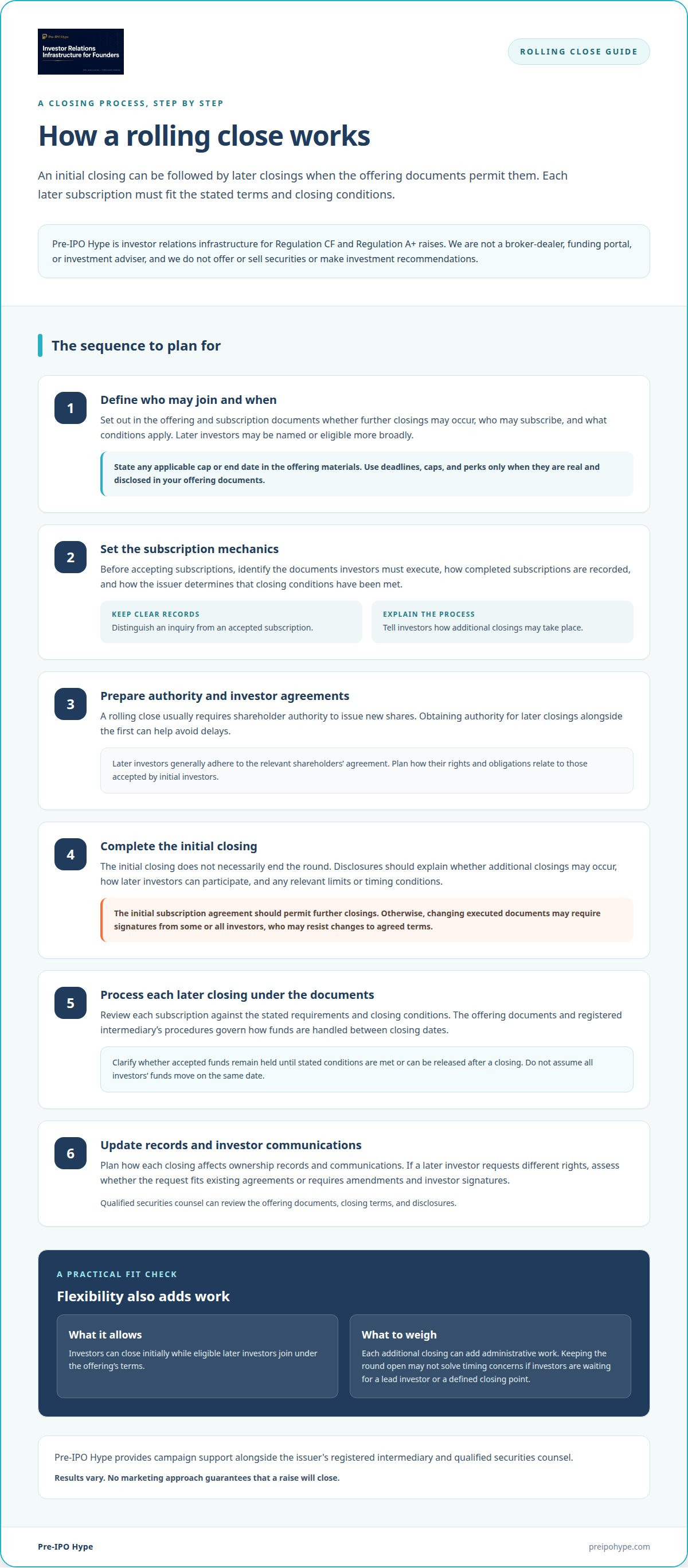
Start by defining the closing process in the offering and subscription documents. State that additional closings may occur, who can subscribe, and what conditions apply. For example, the documents can provide for an initial closing followed by later closings for eligible investors. Qualified securities counsel can review how that structure fits the offering.
Establish the mechanics for each closing before accepting subscriptions. Identify the documents investors must execute, how completed subscriptions are recorded, and how the issuer determines that closing conditions have been met. A consistent process separates an inquiry from an accepted subscription and creates a clear record of which investors joined at each closing.
When a prospective investor submits a subscription, compare it with the applicable offering documents and closing conditions. The issuer should follow the same stated process for each investor. If a later investor requests a different right or obligation, consider how that request relates to existing agreements before proceeding. Qualified securities counsel can assess whether document changes or additional approvals are needed.
After each closing, update the company’s records to reflect the new investment and ownership. Every rolling close can add administrative work, including updating company books and executing share certificates. Keep a closing-specific record of signed documents and issued shares to track what changed at that stage. Ensure the records match the executed documents.
Repeat the subscription review and recordkeeping process for each later closing. Apply the schedule, conditions, and limits set out in the offering documents. If the documents specify an end date or cap, monitor it as subscriptions progress. Use deadlines, caps, and perks only when they are real and disclosed in your offering documents. Do not treat an informal expression of interest as a completed closing or finalized investment.
End the rolling-close period according to the stated process. Record that no further closings will occur under the offering and complete the related company records. If share issuance requires filings, address them as part of closing administration. The exact paperwork depends on the company’s structure and transaction documents, so qualified securities counsel should guide legal decisions.
What types of fundraising rounds use rolling closes?
No particular funding stage automatically calls for a rolling close. The fit depends on the round’s structure, investor expectations, and closing documents. For example, a company with prospective investors at different decision stages may consider separate closings. A company whose investors expect one coordinated close may prefer a single endpoint. The label alone does not determine suitability.
For a Regulation CF or Regulation A+ raise, the offering structure and documents determine how subscriptions are accepted and closed. A rolling close should fit the issuer’s process and the registered intermediary’s role. Founders can map the proposed schedule against investor communications, subscription handling, and closing conditions. Qualified securities counsel should assess the legal structure before the issuer adopts it.
Founders asking “what is a rolling close in fundraising?” are asking about a process, not a specific funding stage. Rolling closings may be easier to manage when later investors can join under consistent terms. For example, initial investors might accept one shareholders’ agreement, and later subscribers can adhere to that same agreement. If a new investor requests different rights, the company must consider how those terms affect existing arrangements.
Investor timing matters too. A rolling close may be a poor fit if prospective investors are reluctant to close before a lead investor. An initial closing may not address that underlying obstacle. Identify whether investors are waiting for a specific commitment, shared documentation, or another defined condition. That helps determine whether separate closing dates solve the actual problem.
Administrative capacity is another factor. Each closing can require updated company books, executed share certificates, and applicable filings. Weigh that recurring work against the benefit of accepting subscriptions at different stages. The decision also depends on whether the documents establish clear procedures for later investors. A round with complex rights or repeated document changes may require more coordination than the issuer can manage efficiently.
The question “what is a rolling close in fundraising?” should lead to a practical fit test: identify why multiple closings are needed, confirm the documents support them, and assess investor readiness and recordkeeping. A rolling close is a process option, not a feature of any particular financing stage. For a specific Regulation CF or Regulation A+ raise, qualified securities counsel can evaluate the terms, while the issuer’s registered intermediary manages its role in the offering.
Pre-IPO Hype
Pre-IPO Hype provides investor relations infrastructure for Regulation CF and Regulation A+ raises. We are not a broker-dealer, funding portal, or investment adviser, and we do not offer or sell securities or make investment recommendations. For founders planning a rolling close, campaign support can help keep issuer communications clear as the raise progresses.
Pre-IPO Hype provides campaign support alongside the issuer’s registered intermediary and qualified securities counsel. Investor relations and marketing campaigns, digital marketing and advertising, and content creation and strategy can support the issuer’s communications. This work is separate from decisions about legal structure, securities terms, or whether to accept a subscription.
Founders may need to communicate with different groups at different points in a raise. Campaign planning can help keep the issuer’s materials aligned in purpose and wording while allowing accurate updates on the company’s progress. For example, an update after an initial closing should describe the raise’s status accurately and direct prospective investors to the issuer’s registered intermediary or offering page.
Content support can help turn the issuer’s approved information into clear investor-facing materials. The issuer remains responsible for the offering and its communications; qualified securities counsel handles legal decisions, and the registered intermediary performs its role. This division matters when a rolling close involves ongoing outreach: campaign materials should not replace offering documents or create a different impression of the terms.
Pre-IPO Hype’s Custom Investor CRM supports lead scoring and attribution tracking. As part of campaign support, it can help the issuer organize engagement information for communications. It does not replace the intermediary’s offering process or counsel’s legal review. Founders preparing a Regulation CF or Regulation A+ raise can consider this support when they need coordinated investor relations and campaign materials.
Pre-IPO Hype supports campaigns, not securities activity or legal decisions. The issuer’s registered intermediary and qualified securities counsel remain central to the offering process. Results vary, and no marketing approach guarantees that a raise will close.
Contact Pre-IPO Hype to discuss campaign support for your raise.
Frequently Asked Questions
What are the potential downsides?
The main downsides are added coordination, ongoing administration, and possible differences in investor terms. For example, an investor joining after the first close may request reporting rights that earlier investors do not have. Addressing that request can prompt document review and distract the team from operating priorities. Separate closing records also need consistent updates, as errors and conflicting communications become harder to correct as investors join.
Why use a rolling close?
A rolling close can give a company flexibility when prospective investors are ready at different times. For example, the company could close with investors whose subscriptions are ready while continuing discussions with others. This can suit a round where waiting for every investor would delay the initial closing. The issuer still needs a defined process to handle later subscriptions consistently.
What does a rolling close mean in fundraising?
A rolling close in fundraising means completing an initial closing while allowing additional closings afterward under the offering documents. Investor subscriptions close at different times rather than all together. An expression of interest alone is not an accepted subscription. The issuer follows its documented process to determine when an investor’s subscription becomes part of a completed closing.
What are the benefits of a rolling close for founders and investors?
Founders can begin the closing process with ready investors without waiting for every prospective participant. Investors can decide on different schedules based on the offering materials available to them. For example, a later subscriber can review the issuer’s current disclosures and follow the stated subscription process. These advantages depend on clear communications and consistent terms, not on the closing format alone.
What are the risks and disadvantages of a rolling close?
A rolling close can make investor communications harder to coordinate because participants join at different stages. Later investors may receive updated information while earlier investors rely on prior communications. Accurate records of subscriptions, signed documents, and closing status help reduce confusion. Requests for different rights can add document review and coordination. Qualified securities counsel should guide legal decisions.
Disclaimer
Educational only. Not investment, tax, or legal advice. Pre-IPO Hype is investor relations infrastructure for Regulation CF and Regulation A+ raises. We are not a broker-dealer, funding portal, or investment adviser, and we do not offer or sell securities or make investment recommendations. Any securities offering is made only by the issuer, through its own offering documents and, where required, a registered intermediary.