
Reg CF vs Reg A+: Which Is Right for Your Startup?
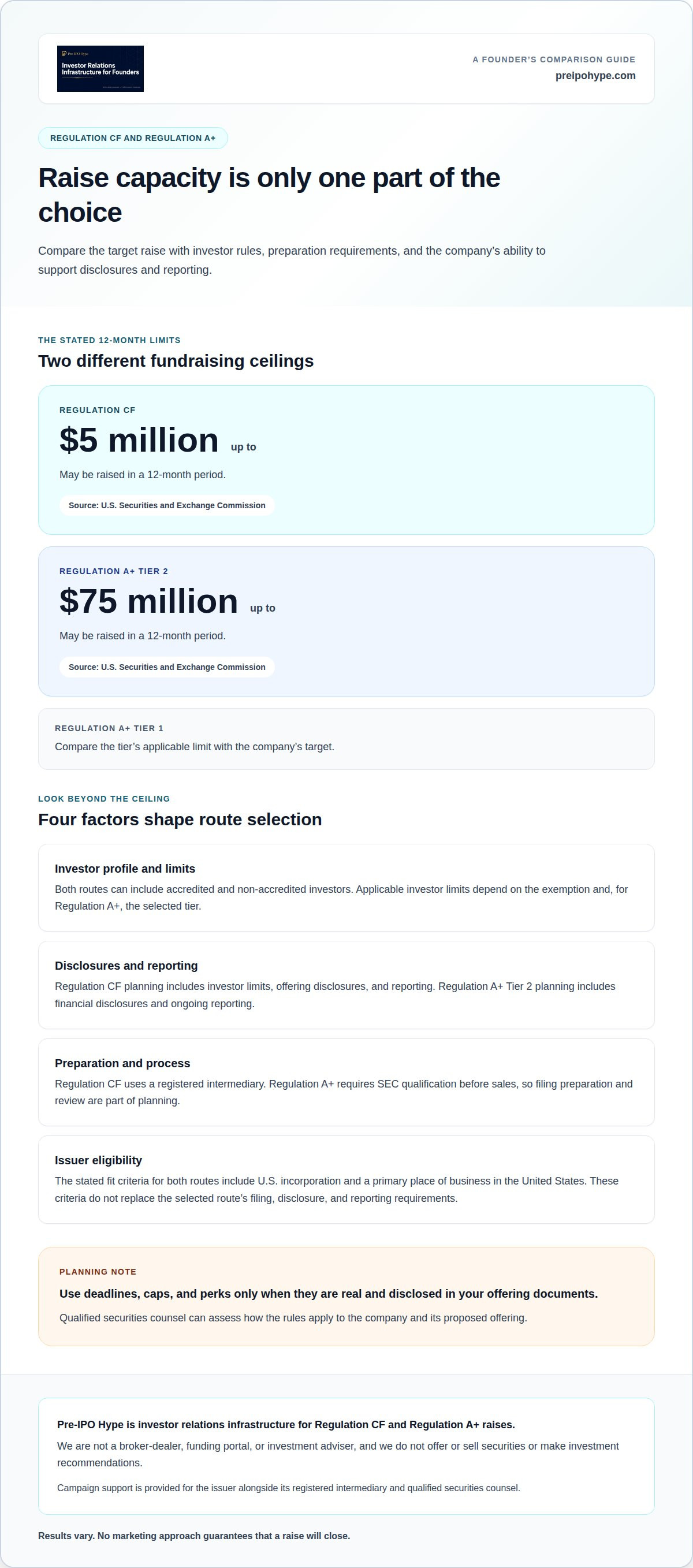
A higher fundraising ceiling doesn’t automatically make Regulation A+ the better fit. For founders comparing Regulation CF and Regulation A+, the key question is which route fits the company’s goal and readiness. The Regulation CF vs. Regulation A+ choice for your startup depends on more than the cap. According to the U.S. Securities and Exchange Commission, Regulation Crowdfunding may raise up to $5 million in a 12-month period, while a Regulation A+ Tier 2 offering may raise up to $75 million in a 12-month period.
If you’re asking, “Regulation CF vs Regulation A+, which is right for your startup?”, compare the investor rules, filing requirements, and ongoing reporting, as well as your target raise. These practical demands can shape your choice as much as fundraising capacity.
This guide explains the differences, including registered intermediary requirements and SEC filings, then offers a decision guide to help you assess the options and plan your next steps.
Key Takeaways
- Match the offering route to your fundraising goal and your company’s capacity for disclosures and ongoing reporting.
- Compare investor eligibility and offering requirements, not just the fundraising ceiling.
- Understand the filing and qualification steps before setting a launch plan.
- Factor registered intermediary requirements and continuing issuer obligations into your decision.
- Keep campaign support done for the issuer alongside its registered intermediary and qualified securities counsel.
So, Which Regulation is Right for Your Company?
Start by weighing your target raise, likely investor base, and capacity to prepare disclosures and reporting. In the United States, a Regulation Crowdfunding offering may raise up to $5 million (5M), according to the U.S. Securities and Exchange Commission.
Investor Eligibility and Limits
Both Regulation CF and Regulation A+ can include accredited and non-accredited investors, subject to applicable limits. The key difference is how investor limits apply under the exemption and, for Regulation A+, the selected tier. This can shape the investor profile a company plans for and how it describes participation in its offering materials.
For founders, investor eligibility is not simply a choice between an open or closed audience. The issuer must account for applicable limits and explain them accurately. If the planned investor base includes non-accredited participants, those rules are an important part of route selection, alongside the fundraising target.
Choosing by Raise Size and Investor Base
Raise size narrows the options, but it does not settle the decision. According to the U.S. Securities and Exchange Commission, a Regulation A+ Tier 2 offering may raise up to $75 million in a 12-month period. Compare the target with the relevant exemption or tier, then assess whether the company can support its disclosures and reporting obligations.
Consider whether the company expects accredited investors, non-accredited investors, or both. A plan for broad participation should account for applicable investor limits and the work needed to explain them. Weigh these factors alongside the preparation schedule and the company’s operational capacity.
Issuer Eligibility Requirements
Issuer eligibility and investor eligibility are separate questions. The stated fit criteria for both Regulation CF and Regulation A+ include U.S. incorporation and a primary place of business in the United States. Meeting these criteria does not remove the need to satisfy the selected exemption’s filing, disclosure, and reporting requirements.
What are the SEC eligibility requirements for Reg CF and Reg A+ issuers? The criteria identified for both include U.S. incorporation and a U.S. primary place of business. Qualified securities counsel can assess how the rules apply to the company and its proposed offering.
| Option | Raise capacity | Investor profile | Planning focus |
|---|---|---|---|
| Regulation CF | Up to $5 million, according to the U.S. Securities and Exchange Commission | Accredited and non-accredited investors, subject to applicable limits | Investor limits, offering disclosures, and reporting |
| Regulation A+ Tier 1 | Compare the tier’s applicable limit with the company’s target | Accredited and non-accredited investors | State securities law requirements and offering preparation |
| Regulation A+ Tier 2 | Up to $75 million in a 12-month period, according to the U.S. Securities and Exchange Commission | Accredited and non-accredited investors, subject to applicable limits | Financial disclosures and ongoing reporting |
Choose the route that fits your fundraising target and investor profile, and that the company can support in terms of disclosures and ongoing obligations.
What are the differences between Regulation CF and Regulation A+?
Regulation CF and Regulation A+ differ in fundraising capacity, preparation, and issuer communications. Both allow companies to reach investors, but the communication rules depend on the exemption and offering structure. In Regulation CF, anyone the issuer pays to promote the offering on the platform must disclose that compensation each time under Rule 205. Securities counsel should review campaign communications for the selected route.
Fundraising Limits and Annual Caps
Regulation A+ has two tiers, so the issuer’s target needs to be compared with the applicable tier limit. The U.S. Securities and Exchange Commission states that a Regulation A+ Tier 2 offering may raise up to $75 million in a 12-month period. Tier choice also affects preparation and continuing obligations, so the ceiling is only one part of the comparison.
To assess the options, match the intended raise to the relevant exemption limit, then consider the company’s readiness to meet the requirements. The amount sought alone does not determine the best route. Investor profile, disclosure work, and ongoing reporting also shape the decision.
Fundraising Timelines
Map the work required for the specific offering instead of relying on a generic launch estimate. Regulation A+ requires SEC qualification before sales, so filing preparation and review affect when the campaign can proceed. Regulation CF uses a registered intermediary, so the issuer must coordinate its offering materials and platform preparation with that intermediary.
Readiness matters under both routes. When financial information and disclosures are organized, the company can plan the required review steps more clearly. Build the schedule around document preparation, intermediary coordination where applicable, and any required qualification, rather than treating campaign launch as the only milestone.
Legal, Compliance, and Dilution Risks
Each exemption carries legal and compliance responsibilities. The issuer must prepare accurate disclosures and follow the communication rules that apply to its offering. For Regulation CF, paid platform promotion requires compensation disclosure each time under Rule 205. For Regulation A+, the offering statement must pass through SEC qualification before sales. Qualified securities counsel should guide legal decisions and review offering communications.
Dilution depends on the securities issued and their effect on existing ownership, not simply on whether the issuer chooses Regulation CF or Regulation A+. If an offering includes equity, issuing additional shares can reduce existing owners’ percentage interests. Evaluate the proposed structure with qualified securities counsel and explain the relevant terms in the offering documents.
Compare the fundraising target, preparation steps, investor communications, and ongoing obligations together. This gives the company a more useful basis for choosing a route than focusing on a single cap or launch milestone.
What is a Regulation A+ exemption?
Regulation A+ is an exemption that lets eligible companies offer securities to the public without conducting a traditional registered public offering. It has two tiers, with distinct requirements for state securities laws, financial statements, and ongoing reporting. For founders considering an equity crowdfunding raise, these obligations affect both preparation and the work required after the offering.
Filing and Qualification
U.S. Regulation A+ offerings require Form 1-A and SEC qualification, according to the U.S. Securities and Exchange Commission. The offering statement presents company and offering information, including financial statements. The issuer prepares the filing for SEC review, then addresses the qualification process before sales begin. That sequence influences when the company can move from preparation to an active offering.
SEC qualification is a substantive step, not just a campaign launch task. The company’s disclosures must explain its business and offering so investors can assess them. Coordinate financial information, legal review, and communications to keep public-facing materials consistent with the offering documents. Qualified securities counsel should advise on legal requirements and filing decisions.
Tier Requirements and Ongoing Work
Tier selection changes the compliance profile. Tier 1 offerings are subject to state securities laws and must be registered and approved in each state where securities are sold. Tier 2 offerings are exempt from state securities laws, but require audited financial statements and ongoing reporting. Tier 1 issuers are exempt from ongoing reporting requirements, while Tier 2 issuers have continuing SEC reporting duties.
Those differences matter beyond the qualification stage. A Tier 2 issuer must plan for recurring reporting and maintain the records needed to support it. A Tier 1 issuer must account for state-level registration and approval across the places where it sells securities. The company’s intended investor reach and internal capacity can help frame the tier comparison.
Preparation, Costs, and Switching
Preparation involves more than drafting Form 1-A. The issuer assembles financial statements, company disclosures, and offering materials, then works through SEC qualification. Accounting and legal work are more extensive than for Regulation CF, and Tier 2 adds audited statements and ongoing reports. These requirements mean the company should evaluate the work involved alongside the amount of capital it plans to raise.
Switching exemptions during preparation can mean revising the filing approach, disclosure materials, financial work, and campaign schedule. For example, if a startup changes its target investor reach, it may need to reconsider whether its initial tier still fits. Counsel can assess the legal implications while the issuer determines what to revise and which work remains usable.
Before choosing a tier, map the intended offering, investor reach, financial statement requirements, and ongoing reporting responsibilities. This comparison helps founders weigh a potential public raise against the preparation and compliance work the company can support.
Funding portals and SEC filings
In Regulation Crowdfunding, the intermediary is part of the offering structure, not simply a campaign vendor. A Regulation CF issuer must use an SEC-registered intermediary, either a broker-dealer or a funding portal. The U.S. Securities and Exchange Commission identifies Form C as the filing for a U.S. Regulation Crowdfunding offering.
Fees fall into separate categories. SEC filing fees and charges from the registered intermediary or platform are distinct, and the amounts depend on the filing and provider terms. Treat them as separate budget lines when comparing routes. There is no single standard figure for SEC and platform fees across Regulation CF and Regulation A+ offerings.
The filing also connects to responsibilities after a campaign closes. According to the U.S. Securities and Exchange Commission, a Regulation Crowdfunding issuer generally must file its annual report on Form C-AR no later than 120 days after the end of its fiscal year. This obligation makes post-offering reporting part of the issuer’s planning, not an administrative afterthought.
Promotion has its own compliance boundary. Anyone the issuer pays to promote the offering on the platform must disclose that compensation each time under Rule 205. The issuer should coordinate campaign messages with its offering materials and registered intermediary. Investors should be directed to the issuer’s registered intermediary or offering page for the official terms and disclosures.
Regulation A+ uses a different filing path. The issuer files an offering statement with the SEC, including company and offering information and financial statements, and must obtain qualification before sales. Regulation A+ issuers also have ongoing reporting duties, with Tier 2 reporting including Forms 1-K and 1-SA. Those filings create continuing work beyond the initial campaign.
Compare the operational sequence as carefully as the fundraising route: identify the required intermediary or filing path, organize the issuer’s disclosures, align campaign communications with filed materials, and plan for post-offering reports. A funding portal handles the platform role in Regulation CF, while a broker-dealer may serve as the registered intermediary. Neither replaces the issuer’s responsibility for accurate disclosures or qualified securities counsel’s role in legal decisions.
This distinction matters in equity crowdfunding because campaign materials and securities filings serve different purposes. The campaign communicates the offering; filings provide formal disclosures and support the issuer’s regulatory obligations. Schedule both, and clarify responsibilities among the issuer, intermediary, and counsel before launch.
Pre-IPO Hype
Pre-IPO Hype is investor relations infrastructure for Regulation CF and Regulation A+ raises. We are not a broker-dealer, funding portal, or investment adviser, and we do not offer or sell securities or make investment recommendations.
Pre-IPO Hype provides campaign support for the issuer alongside its registered intermediary and qualified securities counsel. Our Custom Investor CRM supports lead scoring and attribution tracking.
For support planning a campaign for the issuer alongside its registered intermediary and qualified securities counsel, contact Pre-IPO Hype.
Turn Your Offering Choice Into a Practical Plan
Deciding whether Regulation CF or Regulation A+ is right for your startup should lead to an operating plan, not just a filing choice. Set out who will coordinate disclosure materials, manage campaign communications, and handle investor questions through the issuer’s registered intermediary. Clear responsibilities help the team prepare consistently as the offering develops.
Before advancing launch planning, bring the company’s intended route, communications approach, and internal capacity into the same discussion. Qualified securities counsel should guide legal decisions. The team can then organize campaign work around the offering documents and the issuer’s responsibilities, rather than treating investor outreach and compliance preparation as separate tracks.
Pre-IPO Hype can provide campaign support done for the issuer alongside its registered intermediary and qualified securities counsel.
A thoughtful plan gives your team a clearer foundation for the next stage of its raise.
Frequently Asked Questions
Not sure which regulation is right for your raise?
Start by matching the planned raise, investor profile, and available preparation capacity to each exemption’s requirements. A company with a defined target should also consider the disclosure and reporting work it can sustain. Qualified securities counsel can assess the legal fit; campaign planning can then align with the selected route. Results vary. No marketing approach guarantees that a raise will close.
What is a Regulation CF offering?
A Regulation CF offering lets an eligible company offer securities to accredited and non-accredited investors through an SEC-registered intermediary, either a broker-dealer or funding portal. The issuer files offering information and communicates with prospective investors through the permitted process. For example, a founder planning to reach community supporters and other individual investors can assess whether this structure fits the company’s target and readiness.
After you start raising capital, are there any ongoing filings to make with the SEC?
Yes, Regulation CF generally includes an annual reporting obligation after the offering. According to the U.S. Securities and Exchange Commission, an issuer generally must file its annual report on Form C-AR no later than 120 days after the end of its fiscal year. The issuer should build that report into its post-offering calendar and maintain records that support its disclosures. Regulation A+ reporting obligations depend on the tier.
Are Regulation CF securities restricted?
Generally, Regulation CF securities have resale restrictions for 12 months, subject to exceptions. This means an investor may not be able to resell securities freely soon after purchasing them. The restriction concerns resale, not whether the offering can include non-accredited investors. Issuers should ensure their offering materials explain the applicable limits clearly, and investors should review those materials before making a decision.
What are the main differences between Regulation Crowdfunding and Regulation A+?
The routes differ in intermediary and filing structure, preparation demands, and reporting obligations. Regulation CF uses an SEC-registered broker-dealer or funding portal and a Form C filing. Regulation A+ requires an offering statement and SEC qualification before sales. Compare which process the company can support, including financial disclosure preparation and reporting after the offering.
What are the current fundraising limits for Regulation CF and Regulation A+?
The U.S. Securities and Exchange Commission allows a Regulation CF offering to raise up to $5 million in a 12-month period. Regulation A+ has two tiers: Tier 1 may raise up to $20 million in a 12-month period, and Tier 2 up to $75 million in a 12-month period. Use deadlines, caps, and perks only when they are real and disclosed in your offering documents.
Disclaimer
Educational only. Not investment, tax, or legal advice. Pre-IPO Hype is investor relations infrastructure for Regulation CF and Regulation A+ raises. We are not a broker-dealer, funding portal, or investment adviser, and we do not offer or sell securities or make investment recommendations. Any securities offering is made only by the issuer, through its own offering documents and, where required, a registered intermediary.