
What Is a Form 1-A Filing? Essential Reg A+ Guide
A Regulation A raise begins with a filing, not a sales campaign. If you’re asking what a Form 1-A filing is, it’s the offering statement an issuer submits to the SEC to use the Regulation A exemption from registration under the Securities Act of 1933, according to the U.S. Securities and Exchange Commission. The SEC must qualify the offering statement before the issuer can begin selling securities.
The filing has three parts: a notification, the information required in the offering circular, and exhibits. Understanding those parts is only the beginning. This guide explains how Regulation A’s two tiers differ, what the filing discloses, when a draft may receive non-public SEC staff review, and what reporting continues after an offering. These details help founders assess the work involved and prepare informed questions for qualified securities counsel. Results vary, and no marketing approach guarantees a successful raise.
Key Takeaways
- Understand when an issuer may submit a draft offering statement for non-public SEC staff review and how that fits into the public filing process.
- Compare Regulation A tiers by their offering limits and related requirements before assessing which exemption may suit the raise.
- Use the disclosure requirements to identify the company, management, proceeds, risks, and other information investors need to evaluate the offering.
- Map post-offering reporting obligations, including the annual, semi-annual, and current reports required for Tier 2 issuers.
- Separate filing and legal decisions from campaign support, and involve qualified securities counsel in decisions about the offering.
This guide is an independent summary by Pre-IPO Hype. It is not affiliated with or endorsed by the SEC. For the official source, see the SEC staff Regulation A Compliance and Disclosure Interpretations at https://www.sec.gov/rules-regulations/staff-guidance/compliance-disclosure-interpretations/securities-act-rules and Regulation A at https://www.ecfr.gov/current/title-17/chapter-II/part-230/subject-group-ECFR68d879261fb42fb
Does the SEC review a draft Form 1-A in private?
A Form 1-A is the offering statement used to seek qualification for a Regulation A offering. It gives the SEC information about the issuer and the proposed securities before sales can begin.
A non-public draft is an offering statement submitted for SEC staff review without an initial public filing. Under Rule 252(d), eligible Regulation A issuers may submit a draft for non-public review. Staff comments and issuer responses are part of that review process. The draft process does not make the offering permanently private: the issuer must later file publicly, and the public record includes the offering materials and related review correspondence.
The public filing must be made no later than 21 days before the SEC qualifies the offering statement. That interval gives the public access to the filed materials before qualification. Qualification is not SEC approval of the investment or a finding that the disclosure is complete for every investor’s needs.
Form 1-A has three parts: Notification, information required in the offering circular, and Exhibits. Part I gives basic issuer, security, and offering information and must be provided in XML format. Part II contains the offering circular and is submitted in HTML or ASCII formats that meet SEC EDGAR guidelines. Part III uses standard EDGAR format for the exhibit index, exhibits, and signature block. Submitted documents must be searchable.
An offering circular is the disclosure document that explains the terms and risks of the offering to investors. Its summary should plainly describe the issuer and the offering, while risk factors explain material uncertainties. The issuer also discloses its business, management, use of proceeds, and financial information. Tier 2 offerings have investment limits for certain non-accredited investors, so the offering materials should explain applicable limits clearly.
Form 1-A differs from Form S-1 because it is used for the Regulation A exemption, while Form S-1 is a separate SEC filing for a different securities-law route. Other SEC filings, such as annual reports, serve ongoing reporting purposes rather than initiating a Regulation A offering.
Ask securities counsel about any SEC or state filing fees. Budget separately for legal, audit and preparation costs.
To file, an issuer obtains SEC access codes, prepares Parts I, II, and III in the required formats, and submits searchable documents through EDGAR. The issuer then responds to staff comments and publicly files the offering statement before qualification. SEC review and qualification may take a few weeks to a few months, or longer.
What reports does a Regulation A issuer file after the offering?
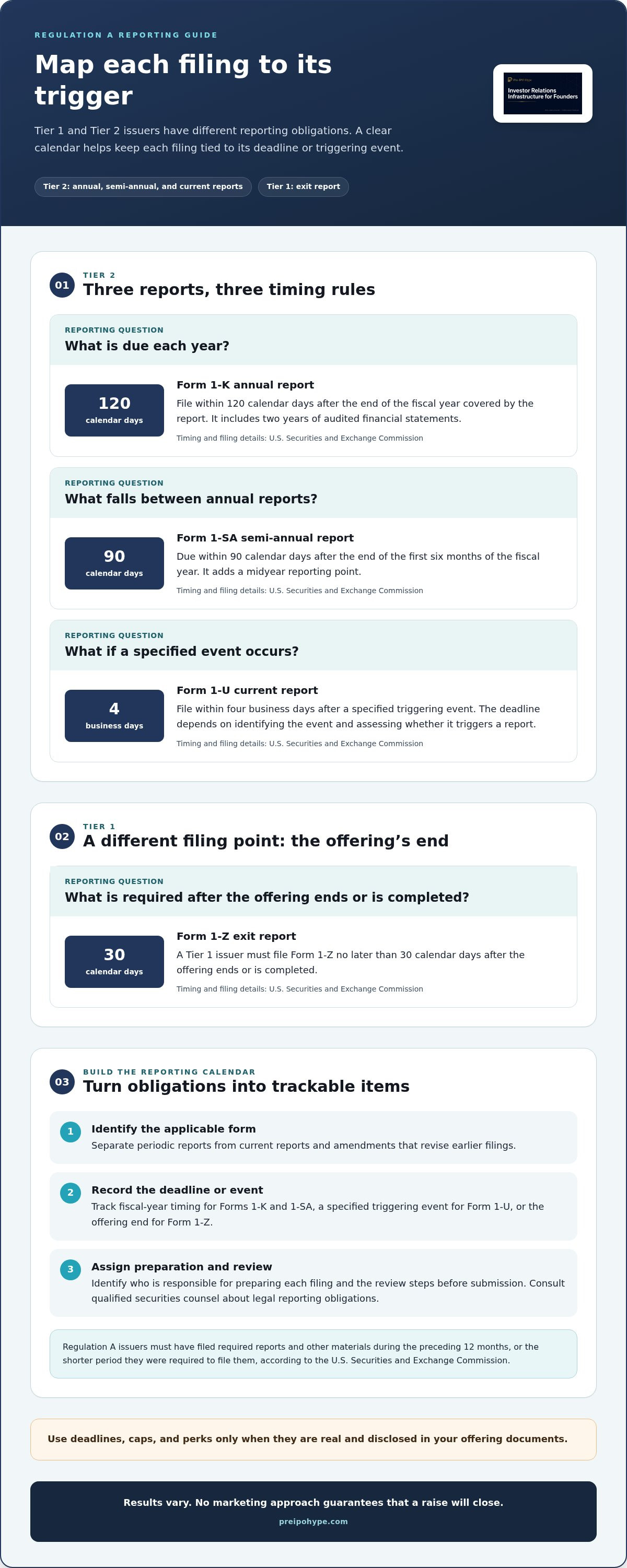
Ongoing reporting means submitting required reports after a Regulation A offering. The schedule depends on the tier, the issuer’s fiscal year, and whether a specified event occurs. A reporting calendar helps founders track each obligation and coordinate financial statements, exhibits, review, and EDGAR submission. It should distinguish periodic reports from amendments that revise earlier filings.
Form 1-K is the annual report for a Regulation A Tier 2 issuer. According to the U.S. Securities and Exchange Commission, the issuer must file Form 1-K within 120 calendar days after the end of the fiscal year covered by the report. It includes two years of audited financial statements. Form 1-K/A amends an earlier Form 1-K filing, so the issuer should identify which information changes and keep the amended material consistent with its records.
Form 1-SA is the semi-annual report for a Regulation A Tier 2 issuer. According to the U.S. Securities and Exchange Commission, it is due within 90 calendar days after the end of the first six months of the fiscal year. The report adds a midyear reporting point between annual filings. Assigning responsibility for financial information and review before that period ends can help the issuer organize its submission.
Form 1-U is the current report used after a specified triggering event. According to the U.S. Securities and Exchange Commission, a Tier 2 issuer must file Form 1-U within four business days after such an event. Because the deadline depends on the event, the issuer needs a process to identify relevant developments, assess whether reporting is triggered, and prepare the filing. Legal decisions about reporting obligations belong with qualified securities counsel.
- Form 1-K: annual report, with audited financial statements covering two years.
- Form 1-SA: semi-annual report after the first six months of the fiscal year.
- Form 1-U: current report following a specified triggering event.
Tier 1 and Tier 2 reporting obligations differ. A Tier 1 issuer must file Form 1-Z no later than 30 calendar days after the offering ends or is completed, according to the U.S. Securities and Exchange Commission. Form 1-Z is an exit report. Separately, Regulation A issuers must have filed required reports and other materials during the preceding 12 months, or the shorter period they were required to file them, according to the U.S. Securities and Exchange Commission.
Use deadlines, caps, and perks only when they are real and disclosed in your offering documents. Keep a reporting calendar that identifies the applicable form, its trigger, who is responsible for preparing it, and the review steps. This helps distinguish amendments to offering or annual filings from ongoing reports.
Business, property, management, and transactions disclosures
A business disclosure explains what the issuer does and how its operations have developed. Form 1-A calls for material events in the company’s development during its existence. Prepare a clear account of the business, significant developments, and factors that could affect its prospects. Keep the description consistent with the offering statement and supporting documents. For example, a change in the company’s operating model should be reflected wherever that model is described.
A property disclosure identifies property relevant to the issuer’s operations. Explain how important property supports the business, such as a facility used to provide services or produce goods. Connect each description to the company’s operating model so readers can understand its role. Describe the property and its relevance accurately, without implying that every asset is equally important to the issuer.
Management disclosure identifies the people responsible for directing the issuer. Form 1-A also calls for management compensation and beneficial ownership information. Beneficial ownership describes securities held or controlled by relevant owners. Present these details consistently, so readers can understand who manages the company, who holds ownership interests, and what compensation is disclosed. The offering statement also addresses potential risks, which should reflect the issuer’s actual business and circumstances.
A legal-proceedings disclosure describes specified proceedings involving directors and certain other people. Form 1-A calls for disclosure of proceedings that are material to evaluating a person’s ability or integrity. Identify the relevant person, describe the proceeding accurately, and explain its material connection to that evaluation. Qualified securities counsel can help assess how legal facts apply to the filing.
Use-of-proceeds disclosure explains the principal purposes for offering proceeds and the approximate amount assigned to each purpose. The Form 1-A requirements call for issuers to describe these planned uses. Prepare the explanation around actual plans, such as product development or operating expenses, only when those uses accurately reflect the issuer’s intentions. If proceeds would be allocated differently at different sales levels, explain the allocations clearly in the offering materials.
Existing securityholder sales are transactions in which current holders offer securities for their own accounts. When an offering circular includes these sales, Form 1-A calls for specified information about the selling holders. Distinguish issuer sales from holder sales, and describe the holders and their interests accurately. This helps readers understand who is selling securities and who receives proceeds from each part of the offering.
Before filing, compare the business narrative, management information, ownership details, risks, and proceeds plan across the documents. A change in one area can affect another: a revised proceeds plan may affect the summary, while a material development may change the risk discussion. Keep the offering statement, exhibits, and public offering materials consistent. Issuers should have qualified securities counsel review legal disclosure decisions before submitting the filing under the Securities Act.
Form 1-A purpose and Regulation A exemptions
Form 1-A is the offering statement an issuer files to seek qualification under Regulation A. Founders often ask, “What is a Form 1-A filing?” It is the disclosure document used to pursue an eligible offering under this exemption. Regulation A is an exemption from registration under the U.S. Securities Act of 1933, as amended, according to the U.S. Securities and Exchange Commission. Issuers still submit the required disclosures to the SEC, and sales cannot begin before qualification.
An exemption is a legal pathway that permits an offering without registration under the Securities Act. In the United States, a Regulation A Tier 1 offering is limited to an aggregate offering price and aggregate sales of $20 million in any 12-month period, according to the U.S. Securities and Exchange Commission. A Regulation A Tier 2 offering is limited to an aggregate offering price and aggregate sales of $75 million in any 12-month period, according to the U.S. Securities and Exchange Commission.
These tiers also differ in their financial statement requirements. Tier 1 issuers may provide unaudited financial statements, while Tier 2 offering statements must include audited financial statements, except for interim statements. Tier 1 offerings may also be subject to state securities registration or qualification. Founders can weigh these distinctions when planning filing preparation and identifying state requirements that may apply.
Affiliate sales have separate limits within each tier. In a United States Regulation A Tier 1 offering, selling securityholders that are affiliates of the issuer may offer no more than $6 million in any 12-month period, according to the U.S. Securities and Exchange Commission. In a United States Regulation A Tier 2 offering, selling securityholders that are affiliates of the issuer may offer no more than $22.5 million in any 12-month period, according to the U.S. Securities and Exchange Commission. These limits apply to affiliate selling securityholders, not the tier’s overall offering limit.
Eligible filers are issuers that meet Regulation A’s requirements and are not disqualified from relying on the exemption. Form 1-A addresses disqualification under Rule 262, including whether relevant persons are disqualified or have received a waiver. The answer to “What is a Form 1-A filing?” also depends on whether the issuer and offering qualify for the chosen Regulation A tier. Qualified securities counsel can assess how eligibility rules apply to the issuer’s circumstances.
Before selecting a tier, compare the offering limit, financial statement requirements, potential state-level requirements, and any planned affiliate sales. The offering statement should accurately reflect the issuer’s structure and proposed offering.
Pre-IPO Hype: Custom Investor CRM
Pre-IPO Hype provides investor relations infrastructure for Regulation CF and Regulation A+ raises. We are not a broker-dealer, funding portal, or investment adviser, and we do not offer, sell or recommend securities. This article is educational only and is not legal, tax or investment advice. Pre-IPO Hype fees are never tied to investment results. FWSC and Pre-IPO Hype are paid per form filled out and per meeting booked, with no commission, equity or share of the raise.
For founders planning issuer communications around a Regulation A+ raise, Pre-IPO Hype provides campaign support alongside the issuer’s registered intermediary and qualified securities counsel. Its Custom Investor CRM supports lead scoring and attribution tracking. Investor Relations and Marketing Campaigns can also support outreach done for the issuer, while legal decisions and offering disclosures remain matters for qualified securities counsel.
Results vary, and no marketing approach guarantees a successful raise.
Explore Pre-IPO Hype’s campaign support for your raise.
Plan the next stage of your offering
Knowing what a Form 1-A filing requires is only one part of raise preparation. The next step is coordinating legal review, ownership of disclosure updates, and investor communications around the issuer’s actual readiness. A clear working process can help keep public messaging aligned with filed materials as the offering develops. Founders can use this planning stage to assign owners for content, review, and communications.
Pre-IPO Hype provides investor relations infrastructure for Regulation CF and Regulation A+ raises. We are not a broker-dealer, funding portal, or investment adviser, and we do not offer, sell or recommend securities. This article is educational only and is not legal, tax or investment advice. Pre-IPO Hype fees are never tied to investment results. FWSC and Pre-IPO Hype are paid per form filled out and per meeting booked, with no commission, equity or share of the raise.
Pre-IPO Hype provides campaign support alongside the issuer’s registered intermediary and qualified securities counsel. Our Custom Investor CRM supports lead scoring and attribution tracking. Qualified securities counsel should guide legal decisions about the offering and its disclosures.
Results vary, and no marketing approach guarantees a successful raise.
Thoughtful preparation gives your team a practical foundation for the work ahead.
Frequently Asked Questions
What Is SEC Form 1-A?
SEC Form 1-A is the offering statement an issuer files to conduct an offering under Regulation A. Founders asking what is a Form 1-A filing should think of it as the central disclosure document for the proposed offering, not a marketing document. It organizes information for SEC review and helps establish the record investors use to understand the issuer and its securities. Issuers should keep public communications consistent with filed information.
What is Regulation A?
Regulation A is an exemption from registration under the U.S. Securities Act of 1933, as amended, according to the U.S. Securities and Exchange Commission. It provides an eligible issuer with a framework for certain public securities offerings. A founder asking what is a Form 1-A filing is also asking how the issuer documents its use of this framework. Qualified securities counsel can assess eligibility and legal requirements based on the issuer’s circumstances.
What are the Regulation A dollar limits?
According to the U.S. Securities and Exchange Commission, a Regulation A Tier 1 offering is limited to an aggregate offering price and aggregate sales of $20 million in any 12-month period. A Tier 2 offering is limited to an aggregate offering price and aggregate sales of $75 million in any 12-month period. Founders should assess planned issuer sales and any affiliate sales separately, since the applicable limits can differ.
Where are the Form 1-A disclosure rules?
Use the Form 1-A instructions alongside the applicable Regulation A rules. Rule 252 covers general information about preparing, formatting, and filing the offering statement, while Rule 253 and the Form 1-A Part II instructions set the offering circular requirements. Reviewing the form and rules together helps identify where each item belongs. Qualified securities counsel can help interpret how a disclosure requirement applies to the issuer’s particular facts.
How is the offering circular (Part II of Form 1-A) formatted?
Part II follows one of two formats under the Form 1-A instructions. The issuer uses the Offering Circular format in Form 1-A, or the narrative disclosure format of Part I of Form S-1 or Form S-11. The filed document is HTML or ASCII and must be text searchable on EDGAR. Rule 253 and the Form 1-A Part II instructions set the content requirements. Securities counsel picks the format.
Does Form 1-A require audited financial statements?
Audit requirements depend on the tier selected. Tier 2 offering statements require audited financial statements, except for interim financial statements. Tier 1 may include unaudited statements, which must be labeled “unaudited.” Form 1-A calls for financial statements covering the two most recently completed fiscal years. The issuer’s accounting records and reporting period inform which statements need to be prepared for submission.
Disclaimer
Educational only. Not investment, tax, or legal advice. Pre-IPO Hype is investor relations infrastructure for Regulation CF and Regulation A+ raises. We are not a broker-dealer, funding portal, or investment adviser, and we do not offer or sell securities or make investment recommendations. Any securities offering is made only by the issuer, through its own offering documents and, where required, a registered intermediary.

