
How to Build an Investor Persona for Your Reg CF Campaign
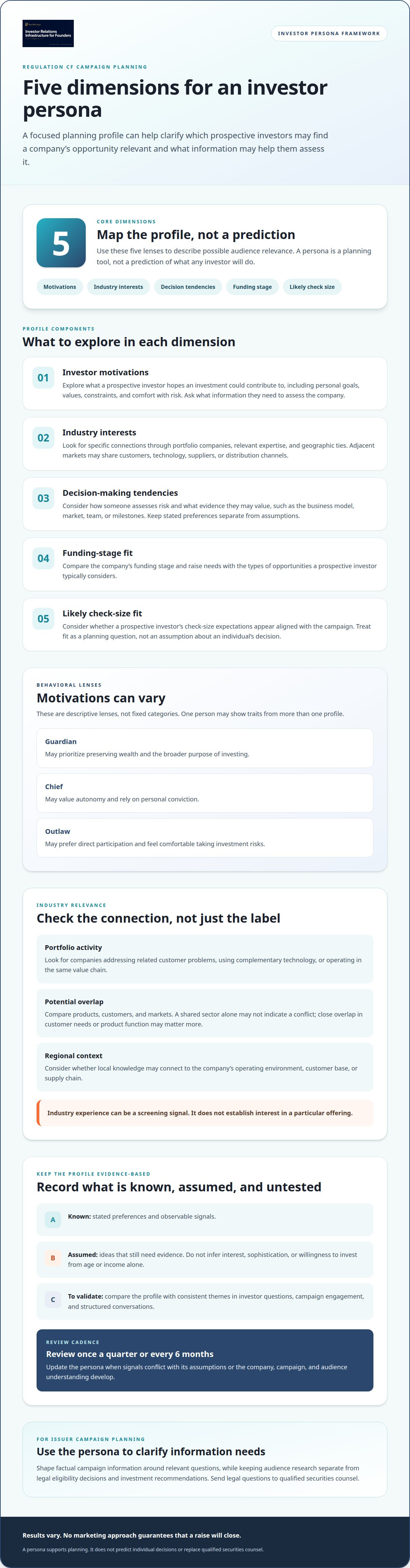
To understand how to build an investor persona for a Regulation CF campaign, define the profile across five dimensions: investor motivations, industry interests, decision-making tendencies, funding stage, and likely check size. Use these dimensions to describe which prospective investors may find the company’s opportunity relevant and what information could help them assess it. Treat the persona as a focused planning tool, not a prediction of what every investor will do.
Founders often know their company’s story but need clarity about which audiences may connect with it. A useful persona makes that task more concrete. This article explains how to map investor priorities, identify relevant industry connections, account for decision-making tendencies, and assess whether an investor’s stage and check-size expectations fit the campaign. The goal is to align the company’s actual offering with the information prospective investors need to make their own decisions.
You’ll also see how these insights can shape campaign messaging and outreach for the issuer without relying on assumptions or overstating demand. Results vary, and no marketing approach guarantees that a raise will close.
Key Takeaways
- Build a persona around motivations, industry interests, decision habits, funding stage, and likely check size.
- Look for alignment between prospective investors’ goals and values and your company’s needs.
- Prioritize industry relevance, while considering whether an investor’s existing portfolio creates a potential conflict.
- Account for how investors assess risk and make decisions when shaping campaign information and outreach.
- Compare your company’s funding stage and raise needs with the types of opportunities a prospective investor typically considers.
Founder and investor motivations
A useful persona connects an investor’s goals and decision-making habits with your company’s needs. Build it as a planning profile, not a prediction of individual investment decisions.
U.S. regulations make it important to distinguish audience research from legal eligibility decisions and investment recommendations. Keep the profile descriptive, and direct legal questions to qualified securities counsel.
According to the U.S. Securities and Exchange Commission, an individual accredited investor may meet the income threshold with over $200,000 annual income. The agency also gives a net worth threshold exceeding $1 million, excluding a primary residence. For an accredited investor applying with a spouse, the annual income threshold is $300,000. Qualifying entities may meet the asset threshold with more than $5 million. These are accreditation criteria, not a complete description of who may consider a particular Regulation CF offering.
Motivations help explain what information a prospective investor may value. A Guardian investor may prioritize preserving wealth and the broader purpose of investing. A Chief investor may value autonomy and rely on personal conviction. An Outlaw investor may prefer direct participation and feel comfortable taking investment risks. These are behavioral lenses, not fixed categories; one person may show traits from several profiles.
Questions for Creating an Investor Persona
An investor persona takes shape through questions about goals, constraints, experience, and decision-making. Ask what the person hopes an investment could contribute to, which risks feel acceptable, and what financial obligations could affect their choices. Then ask what evidence they need to assess a company, such as its business model, market, team, or milestones.
These answers help founders understand an audience without recommending a particular investment. Someone who values a company’s mission, for example, may want clear information about its purpose, while a data-focused reader may look for operating details. Record stated preferences separately from assumptions, then use the distinction to shape factual campaign content.
Segmenting Investors by Profile and Behavior
Segmentation groups prospective investors by relevant characteristics, such as age, income, investing experience, and decision-making behavior. Use those traits to understand differences in information needs, not to infer wealth, sophistication, or willingness to invest from age or income alone.
A practical template can include a profile label, goals, constraints, industry interests, preferred evidence, and behavioral tendencies. For instance, a first-time investor who prioritizes a company’s purpose may need a clear explanation of its business and risks. A more experienced investor may focus on portfolio fit and company milestones. Treat both examples as hypotheses to test.
Identify goals by asking what the person wants their finances to support. Explore constraints by asking about existing commitments and comfort with risk. Discuss liquidity needs by asking when they may need access to their funds, without assuming an early-stage investment suits those needs. The SEC thresholds above describe accredited investor criteria, not an individual’s goals or risk tolerance.
Validate each persona against available evidence, such as consistent themes in investor questions, campaign engagement, and structured conversations. Update the profile when those signals conflict with its assumptions. Review personas once a quarter or every 6 months as the company, campaign, and audience understanding develop.
Common mistakes include treating a persona as a real person, equating income with investment interest, and relying on stereotypes as evidence. Keep the profile focused on observable preferences and relevant company fit. Recording what is known, assumed, and still needs validation makes the persona more useful for campaign planning.
Investor industry focus
Industry alignment helps founders identify investors whose experience or portfolio may connect with the company’s market. Assess that connection through actual portfolio companies, relevant expertise, and geographic ties.
Start with the company’s core industry, then identify adjacent markets that share customers, technology, suppliers, or distribution channels. A healthcare software company, for example, might consider whether an investor’s portfolio includes health technology or businesses serving similar customers. Make the connection specific: a broad label such as “technology” offers less insight than a clear link to the company’s product or market.
Review prospective investors’ portfolio companies for evidence of relevant activity. Look for businesses addressing related customer problems, using complementary technology, or operating in the same value chain. Industry experience may help an investor understand the company’s market context, but it does not establish interest in a particular offering. Use it as a screening signal, not a prediction.
Portfolio overlap also calls for careful judgment. An investor with a likely competitor in their portfolio may be reluctant to invest in a competing company. Compare products, customers, and markets before treating two businesses as direct competitors. A shared sector alone may not indicate a conflict, while close overlap in customer needs or product function may matter more.
Geography can add another layer to the profile. Consider whether local investors or people connected to a strategic region may understand the company’s operating environment, customer base, or supply chain. For a business expanding into a particular market, regional knowledge may be relevant. Keep the connection grounded in the company’s actual plans, rather than assuming that proximity automatically creates investor interest.
A practical industry-fit review can capture:
- Direct relevance: Does the investor’s portfolio include companies in the issuer’s industry?
- Adjacent expertise: Are there connections through customers, technology, suppliers, or distribution?
- Potential competition: Could a portfolio company compete for the same customers or solve the same problem?
- Geographic connection: Does the investor have a meaningful link to a market relevant to the company’s plans?
- Evidence: Which public portfolio details support the proposed fit?
Record the evidence behind each industry-fit judgment. For example, note the relevant portfolio company and the specific connection, rather than writing only “interested in healthcare.” This makes the persona more useful when developing campaign explanations for the issuer. It also separates an informed hypothesis from an assumption and ties industry focus to the company’s real market and plans.
Investor psychology and cognitive biases
Investor psychology shapes how people interpret risk, evidence, and opportunity. A useful persona records decision patterns without assuming that everyone in a category behaves alike.
Start by noting how a prospective investor describes risk. One person may focus on the possibility of loss, while another may accept uncertainty when a company’s mission feels meaningful. A Chief investor may trust personal intuition more than balance sheets or price-to-earnings comparisons. That preference can influence which campaign details feel persuasive, even if the person still reviews formal information.
Intuition can also create resistance. A Chief investor may avoid a new investment path because it simply does not feel right. That reaction offers insight into decision style, not proof that the person misunderstood the company. Founders can respond with a clear explanation of the business, its risks, and its plans. Persuasive messaging should not replace balanced information.
Trend-following behavior raises a different concern. Investors who respond to market trends should consider whether the information they consume is reliable and balanced. An Inspector may be burned by chasing investment trends. A persona can capture whether someone tends to follow popular narratives, investigate claims independently, or wait for more information before forming a view.
Use these patterns to guide how campaign information is organized, not to exploit a bias. If a reader relies heavily on intuition, for example, a direct explanation of the company’s purpose may help clarify its rationale. If a reader follows market narratives, present company-specific facts clearly so the opportunity is not reduced to a sector trend.
- Risk response: Does the person focus on potential loss, uncertainty, or the company’s purpose?
- Evidence preference: Do they lean on personal conviction, company information, or comparisons?
- Decision pace: Do they decide after an initial impression or seek more detail first?
- Trend influence: Do market narratives shape their attention, and do they seek balanced information?
These are prompts for describing behavior, not permanent labels. A person might rely on instinct in one context and request detailed evidence in another. Record examples from actual questions or conversations, then separate observed behavior from interpretation. For instance, “asked how the product differs from alternatives” is an observation; “skeptical of the sector” is an interpretation that needs more evidence.
Review the profile when new conversations challenge its assumptions. If a persona predicts interest in market trends but readers repeatedly ask about the company’s operating model, revise the profile. This keeps campaign communication grounded in real questions and helps founders explain the opportunity without overstating certainty or appealing to fear of missing out.
Investor stage and check-size fit
Investor fit depends on more than interest in the company’s sector. Compare the company’s development stage with an investor’s mandate, participation patterns, and capacity for early-stage risk.
A seed-stage company and a business preparing for later growth raise different questions. At seed stage, an investor may focus on the founding team, early product evidence, and plans to test the market. At a later stage, they may look for operating history, customer retention, or a repeatable sales process. These are examples, not universal rules; assess each investor’s stated focus.
Check-size fit means considering whether an investor’s usual participation aligns with the issuer’s campaign structure. Don’t infer an expected check from someone’s income, job title, or apparent wealth. Instead, look for direct indications, such as publicly described investment activity or stated preferences. A mismatch can make an audience less relevant, even when the sector appears aligned.
Fund size and portfolio strategy can also indicate fit. A large investment firm may focus on opportunities requiring a different scale of participation than an early-stage campaign can accommodate. Conversely, a firm with limited assets under management may not have capacity for a larger company’s financing needs. Treat these as screening considerations, not automatic exclusions.
Assess risk tolerance and time horizon by asking how the investor handles possible losses and when they may need access to invested funds. Someone with near-term liquidity needs may face different constraints from someone able to leave capital invested longer. These answers describe suitability considerations, not a recommendation about whether anyone should invest.
Build a simple fit record for each investor profile:
- Company stage: What evidence and milestones does the company have today?
- Investor mandate: Does the investor consider businesses at this stage?
- Participation pattern: What level of involvement or check-size range has the investor described?
- Risk and time horizon: How does the investor describe uncertainty and liquidity needs?
- Evidence source: Is the fit based on stated preferences, public activity, or an assumption?
For example, a founder might find that an investor follows seed-stage companies but usually participates in later-stage opportunities. Record both observations. The investor’s industry interest may be genuine, while the stage mismatch remains relevant. This distinction helps founders refine a persona without treating a broad signal as proof of likely participation.
Use the profile to plan clear, factual campaign information for the issuer. Base participation expectations on available evidence, and avoid implying that a particular investor will participate. Qualified securities counsel can advise on legal decisions about campaign communications.
Pre-IPO Hype: Custom Investor CRM
Pre-IPO Hype provides investor relations infrastructure for Regulation CF and Regulation A+ raises. We are not a broker-dealer, funding portal, or investment adviser, and we do not offer or sell securities or make investment recommendations.
Pre-IPO Hype provides campaign support alongside the issuer’s registered intermediary and qualified securities counsel. Our Custom Investor CRM supports lead scoring and attribution tracking. Investor Relations and Marketing Campaigns can help the issuer organize campaign communications around audience priorities. Qualified securities counsel should guide legal decisions about offering communications.
To discuss campaign support for your raise, contact Pre-IPO Hype.
Turn your investor persona into a working plan
A persona becomes useful when it informs your team’s next decisions. Use it to identify which campaign questions need clearer answers, what evidence to present, and how to explain the company’s opportunity. Then compare those choices with the responses you observe. Treat the profile as a working hypothesis, not a fixed description of every prospective investor.
That discipline is central to how to build an investor persona that stays relevant as your company and campaign develop. Keep the issuer’s messaging accurate, distinguish observations from assumptions, and direct legal questions to qualified securities counsel.
Keep learning from real audience signals, and let the company’s next stage guide what you refine.
Frequently Asked Questions
What is an investor persona and why create one?
An investor persona is a composite portrait of a recurring audience pattern, not a named prospect or contact list. It gives founders and campaign teams a shared reference when making communication choices. For example, if separate conversations reveal recurring questions about how a company plans to use its offering, the persona can help the team decide where that explanation belongs in its materials.
What information should an investor persona include?
Include a short profile name, the audience pattern it represents, and the evidence supporting that pattern. Add a confidence note so readers can distinguish repeated observations from an early hypothesis. For example, mark a theme as tentative if it comes from one conversation instead of presenting it as an established audience preference. A final field can note which campaign material the insight may help improve.
How to build an investor persona step by step?
Start with one campaign decision the persona should inform, such as how to organize the offering-page narrative. Review existing audience feedback for recurring themes, then draft a concise profile tied to those examples. Share it with the team and use it to assess a specific piece of campaign content. If the profile doesn’t clarify that decision, narrow or revise it before applying it elsewhere.
Disclaimer
Educational only. Not investment, tax, or legal advice. Pre-IPO Hype is investor relations infrastructure for Regulation CF and Regulation A+ raises. We are not a broker-dealer, funding portal, or investment adviser, and we do not offer or sell securities or make investment recommendations. Any securities offering is made only by the issuer, through its own offering documents and, where required, a registered intermediary.