
Investor Relations for Social Impact Companies: A Guide
Effective investor relations for companies with social impact connects a company’s financial story to clear evidence of its social or environmental aims. Investors need to understand what the business does, how it measures progress, and how its impact commitment relates to its strategy. Communicate both consistently.
This can be challenging when impact investing, corporate social responsibility, and environmental, social, and governance practices overlap. This guide explains how they differ, what investors may look for, and how credible impact reporting can support communication during a Regulation CF or Regulation A+ raise.
You’ll also learn how a company’s social-impact commitment shapes investor relations, from defining relevant measures to sharing progress and lessons learned. Results vary. No marketing approach guarantees that a raise will close.
Key Takeaways
- Distinguish impact investing, corporate social responsibility, and values-based investing so your company can explain its approach clearly.
- Connect ESG practices to the company’s operations and explain how they relate to its business strategy.
- Use relevant indicators to describe social or environmental progress alongside financial performance.
- Make the company’s impact commitment specific, measurable, and consistent with its actual activities.
- Communicate progress transparently, including challenges and lessons learned, to give investors a clearer view of the company’s impact.
Impact investing and corporate social responsibility
Impact investing combines an intention to address a social or environmental need with financial objectives. Corporate social responsibility describes how a company takes responsibility for its effects on people and the environment.
Investor Segmentation and Relationship Strategies
Investor segmentation groups prospective investors by their priorities, investment approach, and relationship to the company. It helps shape communications around a company’s mission without treating impact investors, ESG funds, and other investors as one audience.
Impact investors seek measurable social or environmental outcomes alongside financial returns. Socially responsible investors may instead apply positive or negative screens based on values, such as excluding tobacco or weapons companies. ESG investors assess how environmental, social, and governance factors affect a company and its financial prospects. Investor relations infrastructure can help an issuer organize outreach around these different interests, using clear segments and tailored messages rather than assuming every fund has the same criteria.
Public companies communicate with a broad shareholder base and address ongoing market disclosures. Private companies generally communicate with a more limited group of investors through fundraising materials and updates. Nonprofits typically explain their mission, program outcomes, and stewardship to donors or other supporters, rather than presenting the same corporate investment proposition. The right approach depends on the organization’s structure and audience.
For U.S. securities disclosures, social-impact statements in investor materials should be clear, supportable, and consistent with the company’s actual activities. Qualified securities counsel can advise on the rules that apply to a particular offering and its disclosures.
Balancing Impact Goals and Profitability
Balancing impact and profitability means explaining how a company pursues its social mission while managing its business priorities. This matters because investors may differ in how they weigh near-term financial performance against longer-term social outcomes.
A company expanding access to affordable services, for example, may face operating choices that affect both margins and the people it aims to serve. Vague impact goals make it harder for investors to assess trade-offs or understand what progress means. Define the intended outcome, connect it to the business model, and report relevant indicators alongside financial information. Impact investments are made against defined objectives and performance measures, so make the relationship between each measure and its stated goal clear.
In investor relations, designate a corporate responsibility contact to coordinate impact information with finance and leadership. This person can help keep answers consistent across investor materials and progress updates. Corporate social responsibility is voluntary and self-regulated, so explain the policies and practices the company has chosen rather than implying that one universal standard applies.
The regulatory context for retirement investing has also shifted. The U.S. Department of Labor announced a final rule in November 2022 permitting plan fiduciaries to consider climate change and other ESG factors when selecting retirement investments. The U.S. Department of Labor released a regulation in late October 2020 that may limit or eliminate socially responsible investing in retirement plans. These developments show why companies should describe their impact strategy plainly, without suggesting that every investor or fiduciary will assess it the same way.
Environmental, Social and Governance (ESG) practices
Environmental, Social and Governance practices help investors assess how a company manages its effects and business risks. For a company with a social mission, investor communications should connect financial performance with evidence of social or environmental outcomes. Clearly distinguish what the company does, what it measures, and what its results show.
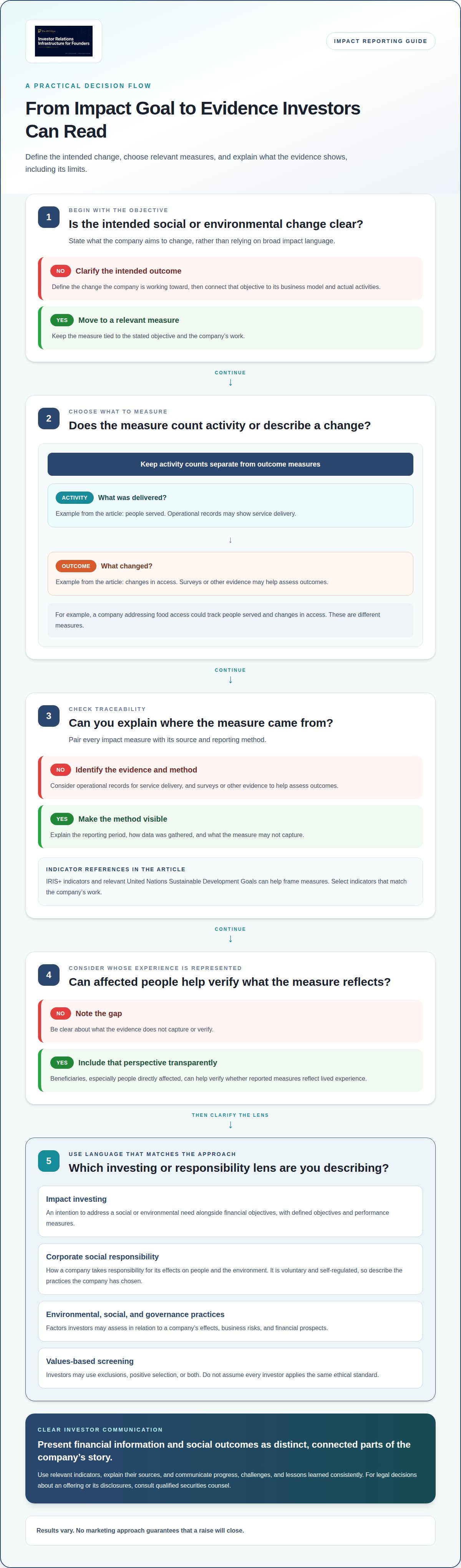
Start measurement with a defined objective. A company addressing food access, for example, could track the people served and changes in access over time. These are different measures: service counts describe activity, while changes in access describe outcomes. IRIS+ indicators and relevant United Nations Sustainable Development Goals can help frame measures. Choose indicators that match the company’s work rather than simply echoing broad ESG language.
Pair each impact measure with its source and reporting method. Operational records may show service delivery, while surveys or other evidence may help assess outcomes. Explain the reporting period, how data was gathered, and what it may not capture. Beneficiaries, especially those directly affected, can help verify whether reported measures reflect lived experience. This makes the impact account more transparent and useful to investors.
Environmental and religious values can also shape investor priorities. One investor may avoid companies associated with petroleum or animal testing; another may seek businesses advancing renewable energy. Values-based screening can include exclusions, positive selection, or both. Describe the company’s actual practices and impact objectives without assuming that every investor applies the same ethical standard.
What do impact measurement, assurance, and investor relations cost a startup? Scope depends on the indicators selected, available data, reporting needs, and whether independent assurance is included. These factors shape the work involved, so one estimate would not apply to every company.
Investor relations infrastructure can help an issuer present financial information and social outcomes as distinct but connected parts of its story. This may involve organizing measures, explaining their sources, and aligning campaign materials with the company’s documented claims. Keep the distinction clear: an impact result is not a financial return, and neither should be presented as evidence of the other.
Good governance reinforces that distinction. Assign responsibility for impact data, document how measures are calculated, and keep updates consistent with underlying records. If a measure changes, explain why and how the new method affects comparisons. This gives investors a clearer basis for assessing both the company’s performance and its stated social or environmental purpose.
Report impact investing transparently. It targets measurable outcomes, with financial and social or environmental performance reported for accountability. Involve beneficiaries in verification at least once during the investment period.
Company social-impact commitment
A social-impact commitment links a company’s mission to its business choices and intended outcomes. For investors, the key question is whether that intention is reflected in operations, targets, and reporting.
Defining the Company’s Social-Impact Commitment
A company’s social-impact commitment states what change it intends to support and how its work contributes. A specific commitment gives investors a clearer basis for understanding the company’s mission and use of capital.
For example, a company focused on access to healthy food could identify the community it serves, the barrier it addresses, and the service it provides. Its target should describe a result the company can track, not simply restate its purpose. Then explain how progress relates to business activities and what evidence supports the account.
Investor communications should distinguish intention from demonstrated outcomes. A plan to expand a service describes an intention; records showing who received that service describe activity. Evidence that access improved describes an outcome. Keeping these categories distinct helps investors understand what has happened, what remains a target, and where the company is still learning.
Philanthropy may support work that does not fit a company’s commercial model, while an impact-oriented business connects its mission with ongoing operations. The relationship depends on the organization’s structure and activities. For example, a company might explain whether a community program is part of its core service or a separate philanthropic effort. That distinction helps investors assess how the commitment fits the business.
For an equity raise, explain the company’s mission alongside its business model and use of capital. Impact objectives do not replace a clear account of how the company operates. A consistent narrative connects the stated goal, the company’s activities, and the measures it reports.
Status and Investor Relations
B Corp, social enterprise, and benefit corporation describe different aspects of a company’s identity or approach. Distinguishing these terms helps investors understand what each label communicates and what evidence supports the company’s claims.
In investor relations, B Corp status may communicate a commitment assessed through a certification process, while benefit corporation status describes a legal form in jurisdictions that recognize it. Social enterprise generally describes an organization whose business activity pursues a social mission. These labels are not interchangeable, so identify the specific status accurately in company materials.
Investors still need details beyond a label. Explain the company’s certification or legal structure, the mission it pursues, and how that mission informs decisions. For example, materials might connect a stated community benefit to the services offered and the indicators used to track progress. This gives readers context without presenting status as proof of a particular outcome.
Before publishing a claim about certification, corporate form, or investor disclosures, align the wording with company records and offering materials. Founders preparing a Regulation CF or Regulation A+ raise should direct legal questions about status and disclosures to qualified securities counsel. Clear, consistent language lets investors assess the commitment without confusing identity, intention, and results.
ESG highlights
Impact reporting connects a company’s environmental or social purpose with evidence of progress. A useful report also keeps impact outcomes distinct from financial performance.
Investor Relations Websites and Impact Reports
An investor relations website and impact report organize company information so investors can assess its claims. Clear presentation matters because readers need to understand the evidence, its limitations, and how it relates to the business.
Useful support brings together impact measurement, financial communication, and careful review of source material. Look for a process that defines each indicator, identifies its data source, explains reporting periods, and keeps public statements consistent with underlying records. For a company reporting on clean water access, for example, the report could distinguish households served from changes in reliable access.
A website can make this information easier to find. Organize the company’s mission, operating model, impact measures, and investor materials under clear labels. A report should explain the target, measurement method, results, and any limitations. Readers should not have to infer whether a figure describes activity, an outcome, or a future goal.
Present financial information and impact evidence as related but separate views. Explain how the company generates revenue, then describe the social or environmental outcomes connected to its operations. This helps investors consider both the business model and the stated impact without implying that one measure proves the other.
Examples of Impact Communication
Effective impact communication gives investors a specific example, its supporting evidence, and its relevance to the company’s work. This helps readers assess the claim instead of relying on broad language about sustainability.
Consider a hypothetical company providing energy-efficient equipment to community facilities. Its report might describe the equipment installed, the method used to measure energy consumption, and the reporting period. It could then explain what the measured change means for its environmental objective, while keeping that outcome separate from revenue and operating performance.
Another hypothetical example is a company expanding access to affordable healthcare. Its materials could describe the service provided, the population served, and how it evaluates access. If it reports a target, it should label it as a goal, not a completed result. If it reports an outcome, it should explain how the data supports that statement.
Keep information consistent across a website, impact report, and offering materials. Use the same indicator definitions, explain any measurement changes, and present lessons alongside progress. Companies preparing a Regulation CF or Regulation A+ raise should have qualified securities counsel review legal questions about offering disclosures and impact claims.
Pre-IPO Hype
Pre-IPO Hype provides investor relations infrastructure for Regulation CF and Regulation A+ raises. We are not a broker-dealer, funding portal, or investment adviser, and we do not offer or sell securities or make investment recommendations.
For founders preparing an impact-focused raise, Pre-IPO Hype provides campaign support alongside the issuer's registered intermediary and qualified securities counsel. Support can include investor relations and marketing campaigns, digital marketing and advertising, and a Custom Investor CRM. Our Custom Investor CRM supports lead scoring and attribution tracking.
This infrastructure can help when a company needs to communicate its mission, impact measures, and business story consistently during a raise. Legal decisions remain with qualified securities counsel, and investors should be directed to the issuer’s registered intermediary or offering page.
Contact Pre-IPO Hype to discuss campaign support for your raise.
Carry Your Impact Story Forward
The next phase of investor relations for companies with social impact is maintaining communication as the business evolves. Investor updates can reflect current operations, decisions, and progress without overstating what the company has achieved.
As you prepare for a Regulation CF or Regulation A+ raise, consider how communications will stay coordinated throughout the process. Decide who will prepare updates, how changes to goals will be explained, and how materials will remain consistent with company records. Qualified securities counsel can advise on legal decisions about the offering and its disclosures.
A clear plan gives your team a practical foundation for investor conversations, both during the raise and as the company develops. Keep next steps aligned with business priorities and the evidence you can share.
Thoughtful communication can help you build the next stage with focus and care.
Frequently Asked Questions
What is investor relations for social impact companies?
Investor relations for companies with social impact is the work of communicating a company’s business, purpose, and investor information clearly. It can include explaining how the company earns revenue, what social or environmental issue it addresses, and how it tracks progress. For example, a company expanding access to healthcare can distinguish services delivered from changes in access, helping investors understand its activities and intended outcomes.
How can companies choose impact metrics and reporting frameworks, such as IRIS+ or GRI, with professional support?
Start with the impact outcome the company intends to measure, then select indicators that match its activities and available evidence. IRIS+ is one possible source of indicators; GRI may also be considered when relevant to the company’s reporting needs. Issuers can present selected measures and sources clearly in investor communications. The company defines its objectives, while qualified securities counsel advises on legal decisions and offering disclosures.
Disclaimer
Educational only. Not investment, tax, or legal advice. Pre-IPO Hype is investor relations infrastructure for Regulation CF and Regulation A+ raises. We are not a broker-dealer, funding portal, or investment adviser, and we do not offer or sell securities or make investment recommendations. Any securities offering is made only by the issuer, through its own offering documents and, where required, a registered intermediary.