
Essential Investor Marketing Metrics to Track for ROI
The investor marketing metrics to track are those that connect campaign activity with qualified leads, acquisition costs, and business outcomes. These key performance indicators help founders see which channels reach the right audience and whether attention leads to meaningful action. Results vary, and no marketing approach guarantees a successful raise.
It’s easy to focus on traffic, clicks, or a growing email list. Those numbers matter most when they help explain what happens next. A clear measurement plan links each campaign goal to a small set of relevant indicators, helping teams assess performance and make informed decisions.
This article explains how to assess marketing performance, calculate and interpret customer acquisition cost, and understand email metrics such as opens, clicks, and conversions. It also shows how to connect those indicators to business goals during a Regulation CF or Regulation A+ raise. The focus is practical: measure what moves the work forward, and give each KPI a clear purpose.
Key Takeaways
- Assess campaigns against defined goals, not activity alone, and use lead-to-customer conversion to understand whether leads become customers.
- Calculate customer acquisition cost consistently, then interpret it alongside lead quality and the value customers generate over time.
- Connect each KPI to a business outcome so performance data can inform campaign and budget decisions.
- Read email opens, clicks, and conversions together to see where engagement progresses or stalls.
- Use a clear measurement framework to connect channel activity with the outcomes that matter to the business.
1. What Is a Marketing Performance Assessment?
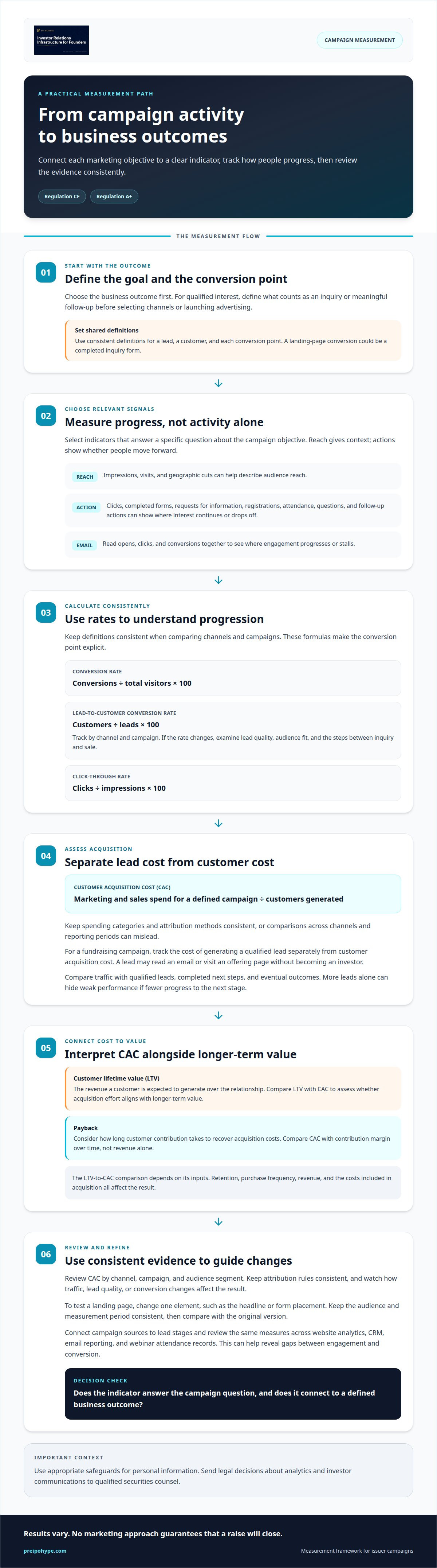
A marketing performance assessment compares campaign activity with defined goals. It helps teams decide whom to reach, which channels to use, and whether activity leads to action. Start with a conversion rate: divide conversions by total visitors, then multiply by 100. For example, a landing page conversion might be a completed inquiry form.
For investor marketing, the lead-to-customer conversion rate shows what share of leads became customers. Divide customers by leads, then multiply by 100. Track this rate by channel and campaign, using consistent definitions for a lead and a customer. If the rate changes, examine lead quality, audience fit, and the steps between inquiry and sale.
Content performance needs more than a page-view count. Compare each asset’s reach with actions such as clicks, form submissions, or requests for more information. Click-through rate is clicks divided by impressions, multiplied by 100. A presentation page, for example, may attract visits but generate few follow-up actions, signaling that its content or next step needs review.
Improve conversion with a clear testing process. Change one landing-page element, such as the headline or form placement, and compare results with the original version. Keep the audience and measurement period consistent. This helps distinguish a useful change from normal variation and avoids relying on traffic alone to assess conversion.
Privacy and securities requirements depend on the data collected, the audience, and the offering. Use appropriate safeguards for personal information, and have qualified securities counsel guide legal decisions about analytics and investor communications.
To measure investor reach and engagement, track impressions, clicks, visits, calls, enrollments, and geographic cuts. The Centers for Medicare & Medicaid Services lists these as possible campaign measures. Choose those that match the issuer’s objectives.
For investor presentations and earnings calls, record registrations, attendance, questions, and follow-up actions, such as visits to the presentation page. Comparing these steps shows where interest continues or drops off.
Tools may include website analytics, a CRM, email reporting, and webinar attendance records. Connect campaign sources to lead stages, then review the same measures across systems to spot gaps between engagement and conversion.
2. Customer acquisition cost
Customer acquisition cost (CAC) measures the resources used to acquire each new customer. Calculate it by dividing marketing and sales spend for a defined campaign by the number of customers it generates. Keep spending categories and attribution methods consistent. Otherwise, comparisons across channels or reporting periods can mislead.
For a fundraising campaign, distinguish customer acquisition from investor lead acquisition. A lead may read an email or visit an offering page without becoming an investor. Track the cost of generating a qualified lead separately from customer acquisition cost, and define each conversion point before comparing campaign performance.
Lead volume alone can hide weak performance. Compare channel traffic with qualified leads, completed next steps, and eventual outcomes. If a channel generates more leads but fewer advance to the next stage, examine audience fit and lead quality. A lower CAC is useful only when the customers acquired are relevant to the business.
Interpret CAC alongside customer lifetime value (LTV), the revenue a customer is expected to generate over the relationship. Compare LTV with CAC to assess whether acquisition effort aligns with longer-term value. The ratio is only as reliable as its inputs: retention, purchase frequency, revenue, and the costs included in acquisition all affect the result.
Payback measures how long it takes customer contribution to recover acquisition costs. Compare CAC with the contribution margin generated over time, not revenue alone. Revenue can rise while service or delivery costs limit how much is available to recover acquisition spending.
Review CAC by channel, campaign, and audience segment. Keep attribution rules consistent, then monitor whether changes in traffic, lead quality, or conversion affect the result. To assess shareholder quality, retention, and turnover, track participation by cohort, repeat engagement, and changes in the shareholder register over time. These measures describe different patterns, so don’t treat engagement as proof of continued ownership.
Evaluate marketing channels by the value customers generate over their lifetime, not only by acquisition cost. A customer lifetime value of $900 and acquisition cost of $300 produce a CLV-to-CAC ratio of 3:1. A CLV-to-CAC ratio below 1:1 can indicate that acquisition spending exceeds the value customers generate over their lifetime.
Spending $1,000 to acquire 100 customers results in a CAC of $10 per customer. Recovering customer acquisition costs within 12 months is a typical business aim. These benchmarks provide context for assessing acquisition performance alongside the quality and longer-term value of customers.
3. Connecting marketing KPIs to business outcomes
A useful KPI links a campaign objective to a business outcome. If the goal is to grow qualified interest, track progression from audience reach to inquiries and meaningful follow-up. Impressions provide context; a KPI shows whether activity supports the stated goal. Define the investor marketing metrics to track before selecting channels or launching advertising.
Choose measures that reflect each campaign’s purpose. A content campaign might focus on qualified inquiries, engagement with key materials, and progress toward a defined business outcome. Each measure answers a distinct question: Did the intended audience see the content? Did people take action? Did that action support the company’s objective?
Metrics record individual measurements; KPIs are the measures selected as critical to a goal. Clicks can help explain visits to a landing page, while completed inquiry forms may be the KPI for lead generation. The investor marketing metrics to track should distinguish supporting signals from the measures that guide decisions.
To combine KPIs with ROI, define campaign costs and the revenue attributed to its activity. A common calculation is (marketing-attributed revenue minus marketing costs) divided by marketing costs, multiplied by 100. Apply consistent attribution rules, and treat ROI as one input to budget decisions, not a complete account of performance.
Investor marketing measures vary by company context. Public companies may assess engagement with investor materials and communications, while private issuers may focus on campaign activity and progression to the issuer’s offering page. Let the audience, business goal, and communication channel determine which measures matter.
Investor relations website metrics can include traffic, new versus returning visitors, page views, and conversions. For example, compare visits to an investor presentation page with clicks on its next-step link. Use these signals to assess whether website activity supports the intended action. The investor marketing metrics to track should reflect that specific objective.
Benchmarks depend on channel, audience, goal, and measurement method. Compare campaigns using consistent definitions and the company’s own historical performance. A click-through rate from one channel may not suit another, so use benchmarks to guide investigation, not define success on their own.
4. Email marketing metrics
Email analytics show whether messages reach the intended audience and prompt useful engagement. Track delivered emails, opens, clicks, unsubscribes, and conversions together. Each measure describes a different step. For example, a message may get opens but few clicks, suggesting the subject line attracted attention while the content or next action needs review. Email measures add context to the broader investor marketing metrics to track.
Use a consistent denominator for each rate. Calculate open rate as opened messages divided by delivered messages, and click-through rate as clicks divided by delivered messages. Some platforms instead report clicks against opens, so label the calculation clearly. Consistent definitions make campaign comparisons more meaningful and help teams interpret changes without mixing unlike measures.
Clicks matter when they lead to a relevant action. Connect email links to the destination page, then measure visits, form submissions, or another defined conversion. For example, if an issuer sends an update linking to its investor presentation, compare clicks with visits to the presentation and subsequent inquiries. This shows where engagement continues or stalls.
Read conversion alongside unsubscribes and bounce activity. A high click rate can still be a poor signal if recipients leave the list or the campaign generates few qualified actions. Separate delivery failures from messages that reach recipients but get no engagement. Review the message, audience selection, and destination page before changing the campaign.
Segment reporting by audience, message type, and acquisition source. An update for existing customers may serve a different purpose from an email introducing an offering to new visitors. Compare like with like. Social media referrals and direct website visitors may respond differently, so source-level reporting helps explain how website traffic connects to email engagement.
Use a simple review sequence for each campaign: check delivery, assess opens and clicks, examine destination-page behavior, then review completed actions. Compare results with the campaign’s stated goal, not an unrelated benchmark. If a message aims to drive presentation views, prioritize those views and follow-on engagement over list growth alone. This keeps measurement tied to the outcome the email was designed to support.
For stronger measurement, align email links with campaign tracking and use consistent naming conventions across analytics platforms. Document the audience, message purpose, and intended action before sending. That record helps explain performance later and supports informed changes to content, targeting, and channel mix. Treat email as one channel in the broader measurement plan, using its results to understand how engagement moves across touchpoints.
Pre-IPO Hype and Campaign Support
Pre-IPO Hype is investor relations infrastructure for Regulation CF and Regulation A+ raises. We are not a broker-dealer, funding portal, or investment adviser, and we do not offer or sell securities or make investment recommendations.
For an issuer preparing a raise, Pre-IPO Hype provides campaign support alongside the issuer’s registered intermediary and qualified securities counsel. Founders can define objectives and measures for campaign activity. Results vary. No marketing approach guarantees that a raise will close.
Measurement starts with clear definitions. The issuer can identify the campaign actions it wants to understand, such as a lead becoming qualified or a visitor taking a next step. Recording those actions consistently makes it easier to review performance across channels. It also separates activity, such as clicks, from the outcomes the issuer has chosen to measure.
Our Custom Investor CRM supports lead scoring and attribution tracking.
Founders preparing a Regulation CF or Regulation A+ raise can consider how to define campaign goals and measures. This campaign support is provided alongside the issuer’s registered intermediary and qualified securities counsel. Counsel should guide legal decisions, including those about communications and offering materials.
Before campaign work begins, the issuer can define its goals, target audience, lead stages, and reporting measures. Campaign support can be organized around those inputs, and the issuer can review the resulting information. This creates a basis for discussing what the metrics show, where engagement happens, and which questions need further analysis.
To discuss campaign support for your Regulation CF or Regulation A+ raise, contact Pre-IPO Hype.
Frequently Asked Questions
Why Are KPIs Important to Your Marketing Plan?
KPIs keep marketing decisions tied to priorities the business has chosen. For example, if a campaign aims to increase qualified inquiries, a KPI focused on qualified inquiries can show whether the plan is advancing that goal. It also helps teams explain why they are adjusting a message, audience, or channel, instead of relying on activity counts that don’t answer the business question.
What Is Marketing Measurement?
Marketing measurement is the process of collecting and interpreting information about marketing activity. A useful system defines each event clearly, such as a form submission or a visit to an offering page, and records its source consistently. This makes it easier to trace campaign performance and identify gaps, such as missing channel information or leads without a follow-up action.
How often should I measure KPIs?
Set a review schedule that matches how quickly each KPI can inform a decision. Review active campaign delivery regularly, while allowing broader measures enough time to show a meaningful pattern. Pair routine monitoring with a deeper review after a campaign milestone. This helps distinguish a change worth acting on from a short-term fluctuation that doesn’t alter the plan.
Metrics vs KPIs: What’s the difference?
A metric records an activity or outcome; a KPI is a metric selected because it signals progress toward a priority. For example, email clicks can help explain recipient responses, while completed requests for information may be the KPI for a campaign focused on inquiries. Keep supporting metrics available, but use the KPI to guide decisions and report against the stated objective.
What Is a Marketing Performance Assessment?
A marketing performance assessment is a structured review of campaign results against the goals and measures set for that work. A practical review compares the intended audience, message, channel, and outcome, then documents what changed and why. For example, if a campaign attracts attention but few people take the intended next step, identify where the journey needs closer analysis.
What types of KPIs should you track?
Choose KPIs based on the business goal: reach and engagement for awareness, qualified inquiries for lead generation, conversions for action, and revenue or retention for business impact. A Regulation CF or Regulation A+ campaign may also monitor progress from initial interest to later engagement. Select measures that support a decision, and interpret them in context. Results vary. No marketing approach guarantees that a raise will close.
Disclaimer
Educational only. Not investment, tax, or legal advice. Pre-IPO Hype is investor relations infrastructure for Regulation CF and Regulation A+ raises. We are not a broker-dealer, funding portal, or investment adviser, and we do not offer or sell securities or make investment recommendations. Any securities offering is made only by the issuer, through its own offering documents and, where required, a registered intermediary.