
How to Manage a Distributed Investor Base Effectively
A distributed investor base needs one reliable source of information, with communications, reporting, access, and onboarding shaped around investors’ needs. Knowing how to manage a distributed investor base means giving institutional LPs the detail and consistency they expect while making key information clear and accessible to individual investors. One approach can overwhelm one group and leave the other underserved.
That balance matters. Investors need timely updates, but they may differ in the detail they need, how they review documents, and what support helps them understand a raise. A sound process sets clear expectations and keeps information organized without treating every investor as if they have the same role.
This article explains how to shape communications and reporting, set appropriate access controls, and make onboarding useful for institutional and individual investors. It also covers how fund managers raising under Regulation D can coordinate these practices with qualified securities counsel. Results vary. No marketing approach guarantees a raise will close.
Key Takeaways
- Set a clear reporting rhythm and use consistent updates so investors know where to find current information.
- Adjust the level of detail and format to institutional LPs’ reporting needs and individual investors’ questions.
- Use onboarding to explain key documents, communication channels, and how to distinguish distributions from returns of capital.
- Make updates accessible across time zones with predictable release schedules and written summaries investors can review asynchronously.
- Keep investor records and access permissions organized, and coordinate campaign support with the issuer’s registered intermediary and qualified securities counsel.
Investor communications and reporting frequency
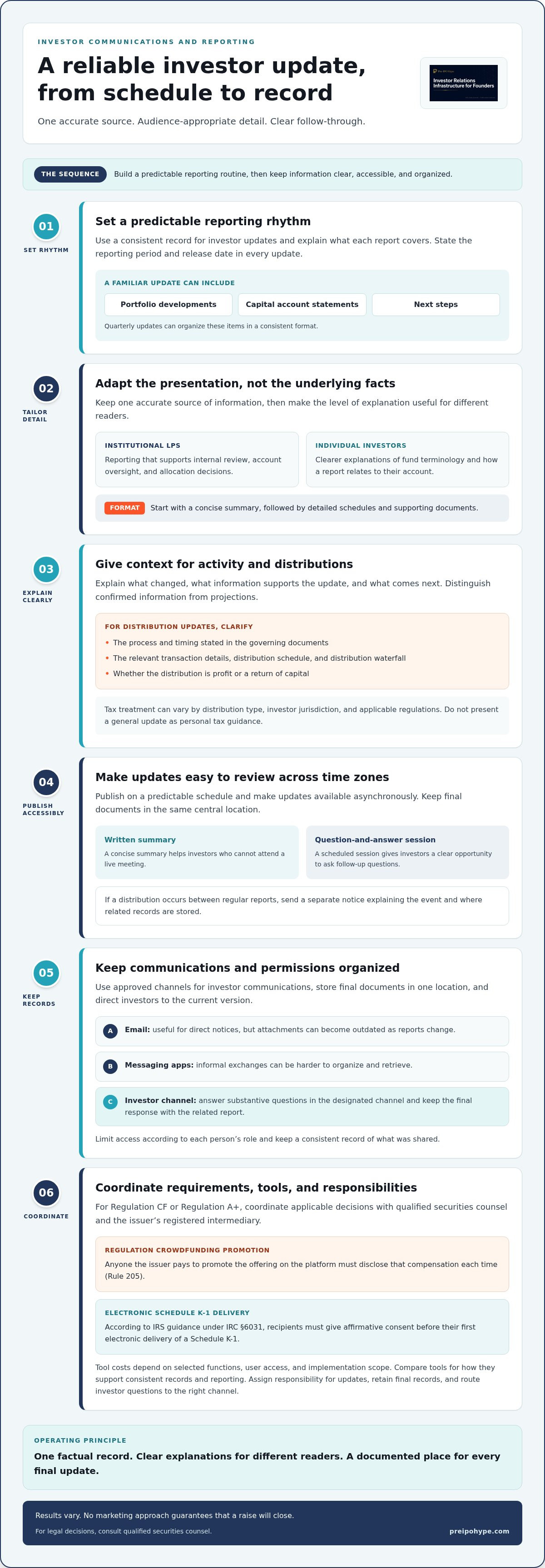
Set a predictable reporting rhythm, use a consistent record for investor updates, and explain what each report covers. For fund managers, communication should connect portfolio activity, capital information, and distribution details without assuming every investor needs the same level of explanation.
Transparent Investor Engagement
Transparent investor engagement means sharing clear, consistent updates that explain what changed, what information supports the update, and what comes next. Investors need context to interpret portfolio activity and understand the purpose of a distribution. For example, pair a performance update with a plain-language explanation of material changes and the reporting period. Keep explanations factual and distinguish confirmed information from projections.
For distributions, explain the process and timing stated in the governing documents, then provide each investor with the relevant transaction details. Investors should understand the distribution schedule and review the distribution waterfall. They should also distinguish profit distributions from returns of capital. Tax treatment can vary by distribution type, investor jurisdiction, and applicable regulations, so avoid presenting a general update as personal tax guidance. This article is not tax advice. Consult a tax adviser about your situation.
Reporting Across Time Zones
Reporting across time zones means publishing updates on a predictable schedule that investors can access asynchronously. It matters because institutional LPs and individual investors may review information at different times, while fund managers still need one accurate reporting record. State the reporting period and release date in each update, and use the same platform as the central reference point for final documents.
Quarterly updates can organize portfolio developments, capital account statements, and next steps in a familiar format. If a distribution occurs between regular reports, issue a separate notice explaining the event and where related records are stored. A concise written summary helps investors who cannot attend a live meeting, while a scheduled question-and-answer session gives them a clear opportunity to ask follow-up questions.
Communication Channels and Risks
Communication-channel management means controlling how investor messages and records move between email, messaging apps, and the official platform. Scattered conversations can leave fund managers with inconsistent versions, unanswered questions, or incomplete records. For example, answer a substantive question in the designated investor channel and keep the final response with the related report.
Email can support direct notices, but attachments may become outdated as reports change. Messaging apps can make informal exchanges harder to organize and retrieve. Set a simple rule: use approved channels for investor communications, store final documents in one location, and direct investors there for the current version. Limit access according to each person’s role and keep a consistent record of what was shared.
Communication Rules and Tools
Communication rules and tools combine the offering’s applicable requirements with a reliable process for investor records. In the United States, securities laws and offering documents shape issuer communications; qualified securities counsel can advise fund managers on decisions for a Regulation D raise, including which communication limits apply.
Investor eligibility and filing steps depend on the offering pathway, so accreditation alone does not determine every requirement. Coordinate the applicable process with qualified securities counsel and the issuer’s registered intermediary. Tax documents depend on how the issuer is taxed. Ask a tax adviser which forms apply and how to deliver them.
Platform and cap table tool costs depend on factors such as selected functions, user access, and implementation scope. Compare tools based on how they support consistent records and reporting, rather than assuming one pricing structure fits every company. A documented process matters as much as the software: assign responsibility for updates, retain final records, and route investor questions to the right channel.
Institutional LP versus individual investor needs
Institutional LPs and individual investors may hold interests in the same vehicle but have different information needs. A useful portal organizes shared fund records and makes relevant details easy to find. Fund managers can maintain one accurate source of information while tailoring explanations to each audience, instead of keeping separate versions of core documents.
Different reporting priorities
Institutional LPs often need reporting that supports internal review, account oversight, and allocation decisions. An investment team may want consistent portfolio updates, capital account information, and documentation suited to its review process. Individual investors may need the same underlying facts with clearer explanations of fund terminology and how a report relates to their account.
Keep the source information consistent, then vary the presentation. For example, a fund update can offer a concise summary followed by detailed schedules and supporting documents. An institutional reader can use the schedules for analysis; an individual can start with the summary and consult the documents as needed. This preserves accuracy without assuming every investor reads reports the same way.
Liquidity, distributions, and allocation context
Investors reviewing a fund should consider their liquidity expectations. This matters in private equity and real estate, where the distribution policy and investment structure shape how investors interpret updates. Fund managers can explain the policy in the governing documents and provide context when describing a distribution. Avoid implying that a fund’s timing or distribution pattern applies to every investor.
For each distribution notice, distinguish profit distributions from returns of capital. Explain which account or investment the notice concerns, and direct investors to the relevant governing document. This helps institutional LPs reconcile records and gives individual investors a clear starting point. Tax treatment can vary by distribution type, jurisdiction, and applicable regulations, so communications should not present general information as personal tax guidance.
Access, clarity, and investor support
Access controls should reflect investor roles, not assumptions about expertise. Give each investor access to records relevant to their account, and keep shared materials in a common location. For instance, an institutional team may need documents for its review, while an individual investor may benefit from a plain-language guide alongside the same official report.
Use investor questions to identify where explanations need improvement. If individual investors repeatedly ask what a portfolio update means for their accounts, add a short explanation to the next report. If institutional LPs need a clearer allocation breakdown, make that information easier to find. These adjustments support engagement while keeping the underlying facts consistent across the investor base.
Founders can map investor groups, account access, and reporting responsibilities in a planning conversation about investor communications.
Investor onboarding and training
Manage onboarding through a consistent process for collecting information, explaining documents, and assigning follow-up responsibility. For each investor, record completed steps, outstanding requests, and who is responsible for responding. This gives founders a clear view of onboarding progress without relying on scattered email threads.
Start with a clear orientation to the issuer, the offering materials, and the communication channels. Explain where investors can access governing documents and how to submit questions. Use plain language to clarify terms such as assets, investor interest, and the relationship between the issuer and the investor. Investors should read the agreement and other governing documents that set out fund distribution policies.
Make original offering materials easy to distinguish from summaries or educational notes. For example, label each document by purpose and direct investors to the issuer’s registered intermediary or offering page for offering information. A short glossary can explain recurring terms, while a separate process for questions can help staff route requests to the right person. Keep explanations consistent with official materials.
Training should address how investors interpret account information, distributions, and tax documents. Investors should distinguish profit distributions from returns of capital, as these terms describe different things. Explain where the governing documents set out distribution policies and how investors can find the relevant information. Avoid presenting general explanations as personal tax guidance, because tax treatment can vary by distribution type and investor jurisdiction.
If the issuer sends tax forms electronically, ask a tax adviser about consent rules before the first delivery. Record the consent and the delivery preference with the investor’s account information, then follow the issuer’s established process for distributing tax documents.
For follow-ups, assign each request an owner, a response channel, and a status. A question about an agreement may need a different response path from a request for an account document. Acknowledge the request, provide the appropriate official resource, and record the response in the designated system. This helps staff handle recurring questions consistently and prevents important requests from getting lost in private messages.
Use onboarding feedback to improve the next investor’s experience. If investors repeatedly ask where to find a document, revise the orientation materials to show its location. If they misunderstand a term, add a concise explanation near the relevant section. Keep training materials aligned with current offering documents, and have qualified securities counsel address legal decisions for Regulation D raises.
How should companies communicate with investors across time zones?
Use a predictable schedule, clear time-zone labels, and written updates investors can read asynchronously. For a company with investors on the U.S. East and West Coasts, an update sent at the same local hour may arrive at very different times. State the date, time, and time zone for live meetings, and make the written record available to all investors afterward.
Choose a release schedule that fits the company’s reporting process, then publish it where investors can find it. A quarterly update, for example, can follow a consistent sequence: portfolio developments, company milestones, and the next reporting date. If an update changes, clearly mark the revised version and identify what changed. Investors then have one shared reference instead of separate email versions.
Plan live meetings for broad access, not just convenience in one region. If a meeting suits East Coast investors but falls outside normal working hours elsewhere, rotate the meeting time for the next session. Share the agenda and supporting materials beforehand, then circulate a written summary and answers to investor questions. This gives people who cannot attend a useful way to follow the discussion.
Use asynchronous communication for information that does not require immediate discussion. A written update can explain a milestone, while a scheduled call can address questions that need direct conversation. For example, send a short notice when a new report is posted, then direct investors to the issuer’s official information channel. Keep substantive answers there so investors in different regions receive the same explanation.
Set a clear process for investor requests. Assign an owner to each question, record its status, and respond through the established channel. If an investor in another time zone sends a question outside the team’s working hours, it can be reviewed during the next work period without relying on instant replies. Explain the communication process during onboarding so investors know where to send questions.
Coordinate internal review before releasing updates across regions. The founder or designated communications lead can confirm that the report, meeting materials, and investor notice use consistent information. For a Regulation D raise, coordinate investor communications with qualified securities counsel. Legal decisions belong with qualified securities counsel, while the issuer remains responsible for accurate communications.
Pre-IPO Hype: Custom Investor CRM
Pre-IPO Hype provides investor relations infrastructure for Regulation CF and Regulation A+ raises. We are not a broker-dealer, funding portal, or investment adviser, and we do not offer, sell or recommend securities. This article is educational only and is not legal, tax or investment advice. Pre-IPO Hype fees are never tied to investment results. FWSC and Pre-IPO Hype are paid per form filled out and per meeting booked, with no commission, equity or share of the raise.
For founders preparing a raise, Pre-IPO Hype provides campaign support alongside the issuer's registered intermediary and qualified securities counsel. Our Custom Investor CRM supports lead scoring and attribution tracking. Investor Relations and Marketing Campaigns support communications conducted for the issuer, alongside the appropriate professionals.
Consider this support when organizing investor communications and campaign activity for a Regulation CF or Regulation A+ raise. The CRM does not replace the issuer's registered intermediary or qualified securities counsel. Results vary. No marketing approach guarantees a raise will close.
To discuss campaign support, contact Pre-IPO Hype.
Build an investor process that can grow with the company
A distributed investor base changes as a company’s raise develops. Treat communication operations as an ongoing part of issuer readiness, not a task that ends after onboarding. Set a regular internal review to assess whether responsibilities, investor records, and information flows still fit the company’s needs.
A useful next step is to define who owns each part of the process. Founders can document who prepares updates, who approves them, and who routes investor questions. This operating map helps teams spot gaps before a new milestone adds coordination work. It also gives incoming team members a clear starting point.
For founders considering how to manage a distributed investor base over time, focus on steady execution: keep the process understandable, adapt it as investor needs change, and coordinate campaign support with the issuer’s registered intermediary and qualified securities counsel. Legal decisions belong with qualified securities counsel.
Build the process deliberately, and give your team room to improve it as the company grows.
Frequently Asked Questions
What does managing a distributed investor base involve?
It involves coordinating investor records, communications, access, and follow-up across people with different information needs. A practical way to manage a distributed investor base is to create an investor map showing each person’s relationship to the issuer, contact details, account, and open requests. Assign communication ownership using that map. Keep offering communications aligned with the issuer’s official materials and established process.
What investor relations software supports a distributed investor base?
Investor relations software can help organize records and campaign activity, but the right fit depends on the issuer’s workflow. When deciding how to manage a distributed investor base, assess whether a system supports reporting processes, data access needs, and existing tools. Compare how each option handles investor contact history, document workflows, and routine reporting tasks. Software should support the issuer’s process, not replace its registered intermediary or qualified securities counsel.
What are best practices for investor updates, reporting, and document sharing?
Use a standard update format that separates completed events, current operating information, and forward-looking statements. Label each document with its reporting period and publication date so readers can identify it quickly. For example, a revised investor presentation should include a brief change note and point readers to the current version. Route offering materials through the issuer’s approved process, and keep general updates consistent with official disclosures.
How can companies organize investor data, permissions, and a single source of truth?
Define which system holds authoritative investor and account records, then assign someone to maintain each record type. Use consistent fields for investor identity, account association, contact preference, and request status. Grant access by role, and remove it when responsibilities change. For example, an employee handling investor questions may need contact records, while sensitive documents can remain limited to authorized users.
How can companies measure investor engagement and satisfaction?
Track observable actions alongside direct feedback. An issuer can review which updates generate questions, whether investors use the document portal, and how quickly requests receive responses. These signals can reveal where information needs clarification, but they do not prove satisfaction on their own. Ask focused questions after an update or meeting, record recurring concerns, and use the findings to improve explanations without changing the underlying facts.
Disclaimer
Educational only. Not investment, tax, or legal advice. Pre-IPO Hype is investor relations infrastructure for Regulation CF and Regulation A+ raises. We are not a broker-dealer, funding portal, or investment adviser, and we do not offer or sell securities or make investment recommendations. Any securities offering is made only by the issuer, through its own offering documents and, where required, a registered intermediary.

