
How to Build an Investor Waitlist with Social Media
A fundraising waitlist grows when social posts give people a clear reason to follow a raise and an easy way to register their interest. To learn how to build a fundraising waitlist with social media, share credible previews, invite useful feedback, and direct interested followers to a simple signup page. Joining a waitlist signals interest, not a commitment to invest.
It’s easy to focus on posting more often. A stronger approach is to make each post part of a conversation, then use people’s questions and choices to shape what you share next. Results vary, and no marketing approach guarantees that a raise will close.
This guide explains how to use behind-the-scenes content, community engagement, audience choices, and social fundraising campaigns to build interest. You’ll also learn how to keep posts clear and consistent so followers understand what the waitlist is for and what to expect next.
Key Takeaways
- Use behind-the-scenes content to make your company’s progress tangible while keeping every update accurate and appropriate for your raise.
- Invite specific questions and feedback so community engagement becomes a two-way conversation, not just a stream of posts.
- Offer clear audience choices to learn which topics and updates matter most to prospective supporters.
- Plan social fundraising campaigns around a consistent message, purposeful posts, and a clear path to the issuer's waitlist, then to the offering page on the registered intermediary once the offering is live.
- Track which content prompts meaningful interest, then use those signals to refine your next campaign.
1. Behind-the-scenes posts and product sneak peeks
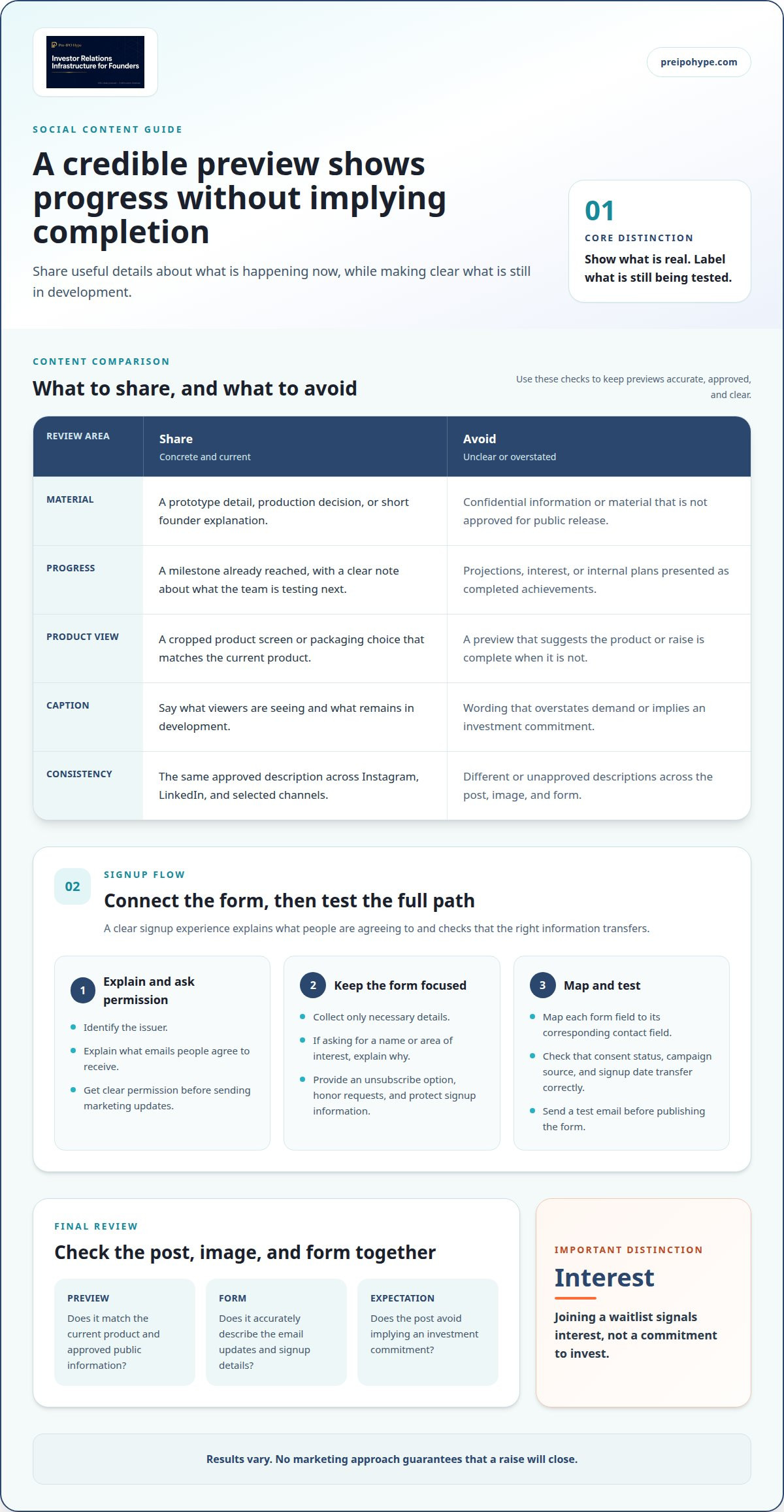
A useful preview shows progress without suggesting that a product or raise is complete. Share a prototype detail, a production decision, or a short founder explanation. For example, show how customer feedback changed a feature, then explain what the team is testing next. Each post gives followers a concrete reason to understand the company’s direction and consider joining its waitlist.
Choose material that is accurate, approved for public release, and useful without exposing confidential information. A founder could show a cropped product screen, describe a packaging choice, or explain a milestone already reached. Add a short caption that states what viewers are seeing and what remains in development. Don’t present projections, interest, or internal plans as completed achievements. Keep every update consistent with the issuer’s disclosures and communications.
For US signups, identify the issuer, explain what emails people agree to receive, and get clear permission before sending marketing updates. Provide an unsubscribe option, honor requests, collect only necessary details, and protect signup information. Have qualified securities counsel review the wording and process.
If a waitlist collects interest before the offering is filed, the page needs the testing-the-waters legend under Rule 206 and accepts no money or commitments. Once the offering is live, posts outside the platform stay within Rule 204's limits.
Connect the waitlist form to an email platform and CRM by mapping each form field to the corresponding contact field, then testing the full signup flow. Confirm that consent status, campaign source, and signup date transfer correctly. Send a test email before publishing the form.
Choose a posting schedule the team can sustain across its selected channels. Plan a recurring sequence: a progress update, a product detail, and a founder explanation. Use a calendar to assign each post a date, owner, asset, and destination. Review comments and signups to identify topics that prompt relevant questions, then adjust future posts without overstating demand.
Give each post one clear next step, such as joining the waitlist through the issuer’s page. Keep the form focused: an email address and a clear explanation of what happens next can reduce friction. If you ask for a name or an area of interest, explain why. A brief confirmation message should acknowledge the signup and set accurate expectations for future updates.
Before publishing, review the image, caption, and linked form together. Check that the preview matches the current product, the form accurately describes the email updates, and the post doesn’t imply an investment commitment. Use the same approved description across Instagram, LinkedIn, and other selected channels. Results vary, and no marketing approach guarantees that a raise will close.
2. Community engagement and user-generated content
A waitlist grows through trust as well as reach. Respond to comments with useful details, then invite a specific contribution. For example, ask followers which product question they want answered in an upcoming founder update. This gives the team a clear content prompt and shows followers that their input shapes the conversation.
Use social features to make participation easy. A poll can ask which of two product uses matters more, while a question box can collect concerns about the customer experience. If asking people to rate an idea, use a consistent scale, such as 1 to 10, and explain what the rating measures. Treat responses as feedback, not evidence of investment interest.
User-generated content might include a customer’s product photo, a comment about a prototype, or an account of a real experience. Ask permission before reposting someone’s content, credit the original creator, and preserve the meaning of their words. Don’t edit a comment to imply stronger support than it expresses. If a customer received a benefit for contributing, disclose that relationship alongside the post.
Referral links show which community posts bring people to the waitlist. Do not pay or reward anyone for sharing a securities offering or for bringing in investors. Rewards tied to investor referrals raise unregistered broker concerns. Under Rule 205 of Regulation Crowdfunding (17 CFR 227.205), anyone the issuer pays to promote the offering in the platform's communication channels must disclose the payment with every communication, and paid promotion elsewhere is limited to the notices Rule 204 allows. Have qualified securities counsel review any incentive before launch.
Set simple moderation rules before inviting public contributions. For example, remove personal information posted in comments, correct factual errors, and move account-specific questions to a private channel. Keep a record of recurring questions, then answer them with consistent, approved language. This helps the team respond without making unsupported claims about the raise.
Close the loop with contributors. If a poll asks whether followers prefer a product walkthrough or a founder Q&A, share the chosen format and explain the decision. Invite people to submit questions for the session, then direct interested followers to the issuer’s waitlist page. This turns a one-time comment into a clear, useful next step.
Nonprofits should set takeover guidelines that clarify their goals, off-limits content, acceptable post volume and formats, and fundraising incentives.
3. Campaign strategy and audience selection
Define the audience before choosing channels or creative. Start with people most likely to understand the company’s product, mission, or market. For example, a clean-energy startup could focus on people who follow distributed energy, along with existing customers and company supporters. Write down why each group may care, what information they need, and which social platforms they already use. A clear audience definition also helps the team avoid treating every follower as equally interested.
A campaign plan clarifies how to build a fundraising waitlist with social media by giving every post one purpose: inviting relevant people to register for updates. Match the message to the audience. A product-focused post can explain the customer problem, while a founder post can outline company progress. Keep the signup request consistent, and direct followers to the issuer’s waitlist page rather than scattering calls to action across unrelated destinations.
There is no single typical conversion rate or signup benchmark for every waitlist campaign. Compare visits and completed signups by channel, audience, and post to identify where the form or message needs adjustment. Treat the comparison as an internal measure of campaign performance, not a prediction of investment interest or fundraising results.
Separate audiences using meaningful signals, not assumptions. A person who asks about product testing may want product updates, while someone interested in the company’s market may prefer business milestones. Use form questions sparingly and explain their purpose. For example, one optional interest question can help tailor future updates without making signup feel like an application. Keep the answer categories clear enough to guide useful follow-up.
Set campaign measures before publishing. Track how people reach the signup page, how many complete the form, and which posts generate relevant questions. Compare Instagram and LinkedIn only when each channel has a defined role and audience. Differences in signups may reflect message fit, audience intent, or form friction, so review the full path instead of judging a post by reactions alone.
Test one meaningful change at a time. Keep the audience and offer consistent while revising the post headline, image, or signup-page introduction. Changing several elements together makes it harder to tell what affected signups. Record the change and outcome in a campaign log, then apply what you learn to the next post for that audience. This gives the team a practical basis for refining its approach.
Deciding how to build a fundraising waitlist with social media also means reviewing each campaign asset as a set: audience, post, signup page, and follow-up message. Confirm that the wording is accurate and people know what updates they’ll receive. For a Regulation CF or Regulation A+ raise, have qualified securities counsel review communications involving the offering. Keep performance reporting factual, and don’t present signups or engagement as investment commitments.
4. Social media fundraising campaigns
Connect each post to one clear next step. Before an offering launches, that step might be joining an email waitlist or attending an informational session. Keep pre-launch education distinct from offering promotion, and have qualified securities counsel review communications about the raise. To plan effectively, map each post to the audience’s next useful action and decide who approves its wording.
To collect signups, use a landing page with an embedded form connected to an email marketing platform and CRM. Configure fields for contact details and consent, then test the form, confirmation message, and data transfer before sharing the page. Check that mobile visitors can complete the form and understand what updates they’re requesting. Limit access to signup information to people who need it for campaign work.
Give people a clear reason to join, such as receiving company updates or an invitation to a scheduled product demonstration. Explain what the waitlist includes and how people can manage future messages. Don’t suggest that signup guarantees access, an investment allocation, or a financial outcome. Use deadlines, caps, and investor perks only when they are real and appear in the offering documents.
Plan social posts in a campaign calendar. For each post, record its purpose, publication date, content, audience, tags, and destination. A sequence could introduce the company, explain a product milestone, answer a common question, and direct interested followers to the issuer’s page. If a post counts down to an event, state the accurate date and explain what the event covers. Keep the schedule aligned with issuer-approved communications.
Measure the path from post to signup. Use channel analytics and campaign tags to track visits, completed forms, and signup sources. Compare these measures by channel and post, then review where people leave the process. Clicks without completed forms may point to a mismatch between the post and landing page, or to form fields that create friction. Record changes so the team can interpret performance over time.
Before launch, review risks across copy, audience, and data handling. Posts can misstate company progress, imply an investment outcome, or blur the line between general information and offering communications. Keep claims consistent with issuer-approved materials, protect signup data, and direct potential investors to the issuer’s registered intermediary or offering page. Decide who handles corrections and updates before content goes live.
For any paid promotion connected to Regulation CF, coordinate the issuer’s review process with qualified securities counsel. Keep records of approved copy, placement details, and revisions so the team can respond consistently if questions arise. These controls help keep campaign communications clear without presenting social engagement as investment intent.
Pre-IPO Hype: Custom Investor CRM
Pre-IPO Hype / FWSC is a marketing agency, not a broker-dealer or investment adviser. We do not sell securities or take a percentage of any raise. We are not a funding portal and do not make investment recommendations.
When a waitlist needs organized follow-up and campaign coordination, Pre-IPO Hype provides campaign support alongside the issuer’s registered intermediary and qualified securities counsel. Our Custom Investor CRM supports lead scoring and attribution tracking. Investor Relations and Marketing Campaigns can support planning and execution for the issuer, while Digital Marketing and Advertising can help organize campaign activity across selected channels.
These offerings support communications, not investment decisions or securities transactions. Contact Pre-IPO Hype to discuss campaign support for your raise.
Turn Waitlist Interest Into a Clear Next Step
A waitlist is most useful when it supports a thoughtful relationship with prospective supporters beyond signup. Decide what people should hear next, who will prepare each update, and how the issuer will keep messages aligned with its offering materials. That operating rhythm helps the team move from public interest to clear, consistent communication.
As you refine how to build a fundraising waitlist with social media, treat each campaign as a learning cycle. Review which messages attract relevant questions, where signups come from, and what followers still need explained. Use those observations to plan the next communication, not to imply investment intent or predict fundraising results. Results vary, and no marketing approach guarantees that a raise will close.
If you’re preparing a Regulation CF or Regulation A+ campaign and want to discuss communications support, connect with Pre-IPO Hype. The next step can be a practical conversation about your campaign’s needs and priorities.
Build your process carefully, keep your messaging grounded, and make sure each next step reflects what your company is ready to communicate.
Frequently Asked Questions
How do you define the goal and target audience for a fundraising waitlist?
Define the goal as a specific learning or communication objective, not a count of people expected to invest. For example, a founder developing a home-energy product might want to find out whether homeowners or installers need clearer product information. Choose one audience segment, explain why its members may care, and shape the signup invitation around updates they would find useful. Keep waitlist membership separate from any investment decision.
How do you promote a fundraising waitlist on Instagram, TikTok, Facebook, and LinkedIn?
Adapt each post to its format while keeping the issuer’s core message consistent. On Instagram, use a concise carousel explaining the company’s problem and solution; on TikTok, share a short founder explanation. Facebook can carry a more detailed community update, while LinkedIn can focus on the company’s market context. Give each post one destination, such as the issuer’s waitlist page, and review which channel brings relevant questions.
What tools can create a fundraising waitlist landing page and collect email signups?
Use a waitlist form on the issuer’s page, connected to an email platform and CRM. Map form fields to matching contact fields and test that consent status, campaign source, and signup date transfer correctly.
Disclaimer
Educational only. Not investment, tax, or legal advice. Pre-IPO Hype is investor relations infrastructure for Regulation CF and Regulation A+ raises. We are not a broker-dealer, funding portal, or investment adviser, and we do not offer or sell securities or make investment recommendations. Any securities offering is made only by the issuer, through its own offering documents and, where required, a registered intermediary.