
Pre-Seed Investor Outreach: A Founder's Guide
Fundraising works better when every investor conversation has a clear place in the process. Investor funnel optimization means mapping prospects from first awareness through engagement and a funding decision, then tracking fit, status, and follow-up in one system. A focused shortlist keeps outreach relevant and protects time for running the business.
Referrals and personal networks can open doors, but they do not replace a repeatable process. Know which investors align with your stage and thesis, what information they need, and where prospects lose interest. This guide explains how to map the funnel, qualify investors, organize prospect tracking, and build acquisition channels beyond bottom-of-funnel paid search. Results vary, and no marketing approach guarantees that a raise will close.
Key Takeaways
- Map each fundraising process from first contact through follow-up so you can see where investor conversations stall.
- Qualify prospects by their investment thesis and fit with your company, not by interest alone.
- Keep investor details, conversation history, and next steps in one tracking system to support consistent follow-up.
- Build investor awareness and engagement through relevant outreach, reducing dependence on bottom-of-funnel paid search.
- Use clear attribution to understand which channels are contributing to investor engagement and where your approach needs refinement.
1. Mapping each venture firm's fundraising process
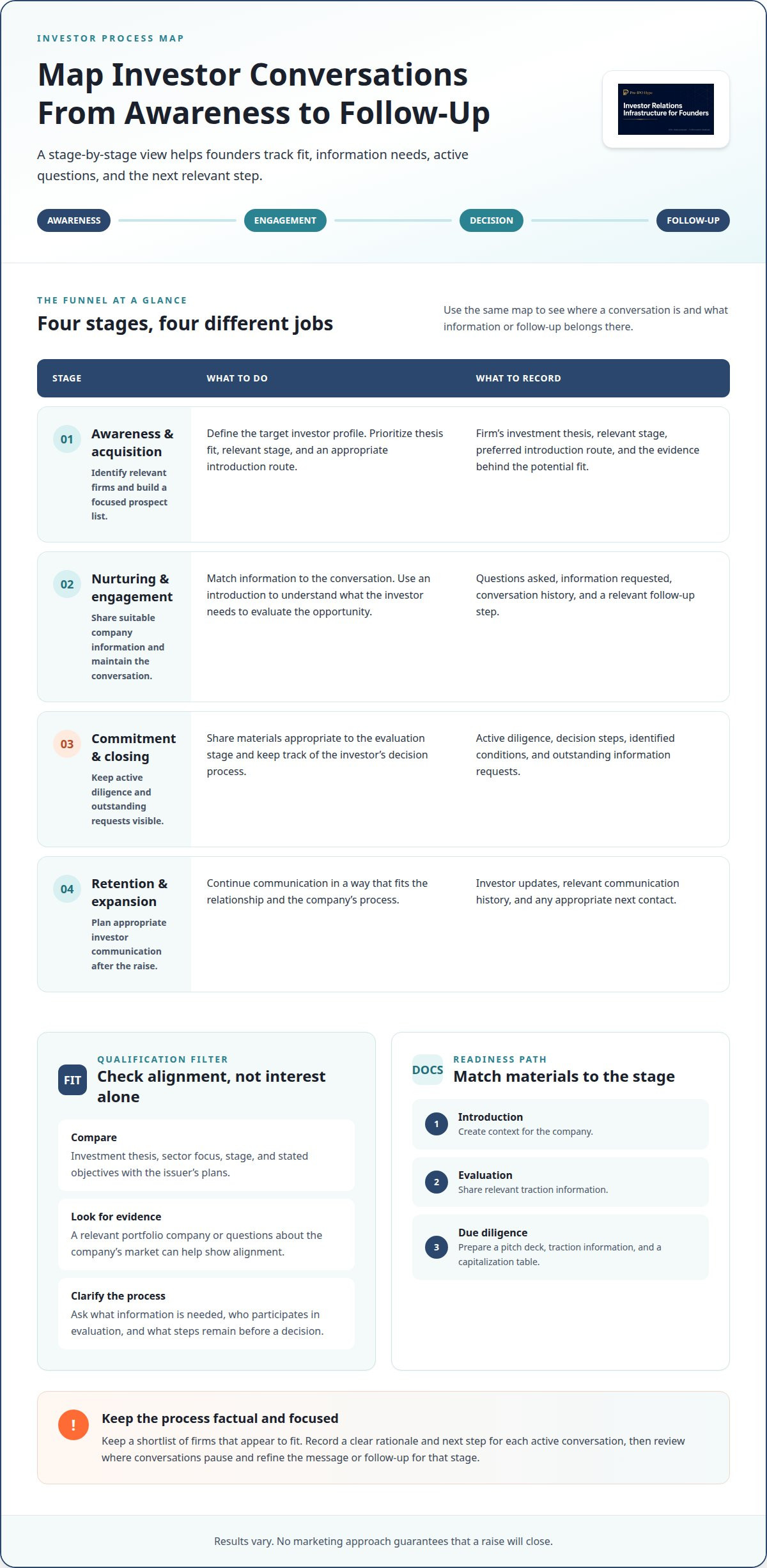
Fundraising needs a process that reflects how each investor evaluates a company. Map the stages from awareness and acquisition to nurturing, commitment, closing, and retention. For each venture firm, record its investment thesis, relevant stage, preferred introduction route, and information needs. A firm focused on pre-seed problem risk may ask different questions from a Series A firm assessing model risk. Your map should reflect those differences rather than treat every prospect as interchangeable.
Build a readiness path around the materials investors use to assess an opportunity. Prepare a pitch deck, traction information, and a capitalization table for due diligence. Match materials to each stage: an introduction creates context, traction details support evaluation, and capitalization information helps diligence proceed. Begin investor networking well before a formal fundraising process so relationships can develop before you request a decision.
Step by step, define the target investor profile, map each firm’s stages and information needs, record every interaction, and set a relevant next action. Review where conversations pause, then refine the message or follow-up for that stage. For angel and venture capital outreach, prioritize thesis fit and warm introductions.
- Awareness and acquisition: Identify relevant firms and build a targeted prospect list.
- Nurturing and engagement: Share suitable company information and track questions or follow-up.
- Commitment and closing: Record active diligence, decision steps, and outstanding requests.
- Retention and expansion: Plan appropriate investor communication after the raise.
A focused process protects the time founders need to run the business. Keep a shortlist of firms that appear to fit, and give each active conversation a clear rationale and next step. A broader, targeted pipeline can support that shortlist without requiring your team to pursue every possible lead. Generic outreach gives investors little evidence of fit and makes follow-up hard to prioritize.
Use social proof as evidence, not pressure. Relevant traction, documented customer progress, and accurate investor updates can support the company’s story. Invented demand or implied commitments undermine trust. Set the fundraising timeline around real process needs, and communicate only substantiated milestones. Use deadlines, caps, and perks only when they are real and disclosed in your offering documents. A mapped funnel makes investor funnel optimization practical: it shows which stage needs attention without obscuring the facts.
2. Qualifying investors and understanding closing conditions
Investor interest is useful when a prospect fits the company and its raise. Qualify each prospect by comparing their investment thesis, sector focus, stage, and stated objectives with the issuer’s plans. Record the evidence behind each fit, such as a relevant portfolio company or questions about the company’s market. This distinguishes a concrete sign of alignment from general interest and gives your team a clear basis for prioritizing follow-up.
Use an introductory conversation to understand the investor’s decision process, not just repeat the pitch. Ask what information the firm needs, who participates in evaluation, and what steps remain before a decision. Record the answers and any conditions the investor identifies. A prospect may show interest but still lack alignment, authority, or readiness to proceed. These distinctions matter when assessing the pipeline and planning the next communication.
Qualified investor lead generation begins with relevance. Build outreach around the issuer’s sector, stage, and evidence of progress, then direct each prospect to information suited to their questions. A founder targeting venture firms might prioritize thesis fit and diligence readiness. Keep outreach factual.
Evaluate budget efficiency by measuring qualified lead volume, not clicks alone. Track which channels bring prospects who meet the issuer’s criteria, engage with company information, and take an appropriate next step. If a channel generates attention without relevant investor interest, review its audience, message, and landing destination before increasing spend. This gives your team a practical basis for shifting budget without assuming every click has equal value.
Qualified securities counsel should assess legal questions about the issuer’s outreach, offering materials, and closing process.
Close the qualification loop by recording each prospect’s fit, questions, decision steps, and next action. Simple statuses such as “researching,” “in diligence,” or “not aligned” make the pipeline easier to interpret. Review these records alongside channel performance so budget decisions reflect qualified engagement, not raw interest. Keep marketing analysis distinct from legal review, and use each to answer its proper question: whether outreach is relevant, and whether the issuer’s process meets its obligations.
3. Tracking investor prospects in a spreadsheet or system
A spreadsheet can track a small pipeline, while a CRM or Airtable can organize records as activity grows. Choose the simplest system that keeps each prospect’s fit, interaction history, and next step visible. Use one shared record per investor or firm so founders and team members work from consistent information.
Start with fields that support a decision: investor or firm name, contact, thesis fit, stage, source, last interaction, current status, open questions, and next action. Add a short note after every meeting, such as “requested updated retention data” or “reviewing sector fit.” These details make follow-up specific and help distinguish an active conversation from an old lead.
Keep pipeline stages consistent. A useful sequence might be identified, contacted, meeting scheduled, evaluating, diligence, and inactive. Assign an owner and next action to each active record. If a prospect asks for an update after a product milestone, record that trigger rather than relying on memory. This makes investor funnel optimization an operating routine, not a spreadsheet cleanup exercise.
- Fit: Record the investor’s thesis, sector interests, and relevant stage.
- Activity: Log meetings, questions, materials shared, and responses.
- Next step: Assign an owner, action, and follow-up trigger.
- Review: Revisit inactive or stalled records and update their status.
To improve response and meeting rates, make each outreach message relevant to the recipient’s stated interests. Refer to a specific company milestone or explain why the issuer’s market fits the investor’s focus. Schedule follow-ups promptly, then use regular updates to nurture interested leads with useful progress. Avoid sending the same generic message to every prospect; a clear reason for reaching out makes the next step easier to understand.
Maintain relationships even when a prospect isn’t ready to evaluate the raise. Record why a prospect is not aligned now, since timing or company progress may change the fit later.
Use regular updates to share progress and milestones with relevant investors. Keep each update factual, consistent with the issuer’s materials, and suited to the recipient’s level of engagement. A partner who asked about customer retention may value that development, while a prospect still learning the business may need broader context. Tracking these preferences helps coordinate marketing and founder follow-up without overstating interest or progress.
4. Reducing reliance on bottom-of-funnel paid search
Bottom-of-funnel search reaches people already looking for a specific company. That intent can be useful, but relying on a single acquisition channel leaves the pipeline exposed to changes in search demand, targeting, and campaign performance. A balanced plan connects paid search with other ways to introduce the company.
Ads that mention a Regulation Crowdfunding offering are limited to the notice permitted by 17 CFR 227.204, or to testing-the-waters content under 227.206 before filing. The issuer's counsel and its intermediary should review them. Regulation A has separate rules.
Start by separating channel roles. Search advertising can capture existing interest in the company, while educational content can help people understand the company before searching for its name. For example, a company developing climate technology might publish clear explanations of its market, business model, and progress. Each piece should reflect documented information.
Build a channel map around the investor journey rather than treating each campaign as a separate effort. An educational article may introduce the company, an email update may share a relevant milestone, and a search ad may reach someone researching the company later. Measure each touchpoint using consistent campaign naming and attribution tracking. This helps distinguish first contact from later engagement without assuming one channel caused every action.
- Search: Monitor which terms bring relevant interest and which attract unrelated traffic.
- Content: Explain the issuer’s market and progress with accurate, useful material.
- Email: Send updates to people who have chosen to receive issuer communications.
- Reporting: Compare engagement and lead quality across channels before reallocating effort.
Review paid search against qualified engagement, not click volume alone. If a campaign attracts visitors but few relevant prospects, examine its search terms, message, and destination. A mismatch can occur when an ad links to a page with different or unclear context. Adjusting these elements can improve traffic quality, though it cannot establish that paid search is the only cause.
Budget decisions should reflect the issuer’s goals and the evidence each channel provides. Compare search activity with inquiry quality and follow-up conversations. If performance weakens, test a limited change to targeting or creative while keeping other variables stable. The comparison will be more useful than changing the budget, message, and landing page all at once.
Keep the marketing system coordinated. A shared calendar can align content publication, company updates, and search campaigns around accurate company information. For example, when the company publishes a product milestone, related content can explain its significance while advertising remains factual and appropriately targeted. Review results regularly, pause placements that do not support the plan, and keep investor communications consistent with company materials.
For a campaign plan that connects investor acquisition, content, and channel tracking, Talk to us about your fundraising marketing
Pre-IPO Hype: Custom Investor CRM
Pre-IPO Hype provides investor relations infrastructure for Regulation CF and Regulation A+ raises. We are not a broker-dealer, funding portal, or investment adviser, and we do not offer or sell securities or make investment recommendations. Pre-IPO Hype fees are never tied to investment results. FWSC and Pre-IPO Hype are paid per form filled out and per meeting booked, with no commission, equity or share of the raise. This article is educational only and is not legal, tax or investment advice.
Our Custom Investor CRM supports lead scoring and attribution tracking. This can help structure how an issuer records prospect engagement and reviews marketing activity as its fundraising process develops.
Pre-IPO Hype also provides Investor Relations and Marketing Campaigns, Investor Relations Infrastructure (CRM, funnels, and automation), and Digital Marketing and Advertising. Investor Relations and Marketing Campaigns support marketing planning for the issuer. The issuer and its registered intermediary control all offering communications.
Contact Pre-IPO Hype to discuss investor relations infrastructure for your raise.
Put Your Fundraising Process to Work
Turn your fundraising plan into a working decision system. Use investor funnel optimization to identify where evidence is strong, where prospects need more context, and where the issuer should adjust its communication. Ground those decisions in actual engagement, not assumptions about what investors may do.
As the raise develops, let the process adapt. A new investor question may reveal a gap in your materials. A channel may attract attention without reaching suitable prospects. Treat each signal as a prompt to review the message, audience, or next step. Keep legal decisions with qualified securities counsel.
A disciplined process gives founders a clearer basis for decisions ahead. Build on what you have learned, keep information accurate, and move forward at a pace that fits the issuer’s needs.
Talk to us about your fundraising marketing
Frequently Asked Questions
What is an investor funnel and how does it work?
An investor funnel organizes how potential investors discover an issuer, consider its opportunity, and decide whether to engage further. It helps founders distinguish broad awareness from active diligence. For example, a prospect who reads an issuer update is at a different point from one who requests supporting documents. Tracking these actions helps teams choose relevant communications without treating every contact as equally ready.
What are the stages of an investor funnel?
A typical investor funnel moves through awareness, acquisition, engagement, commitment, closing, and post-close retention. The stages describe progress, not a guaranteed sequence: a prospect may pause, ask for more information, or disengage. Stage labels should match the issuer’s actual process and avoid implying a commitment before one exists.
Which investor funnel conversion metrics and benchmarks should you track?
Track the share of contacted prospects who respond, responses that lead to meetings, meetings that progress to diligence, and diligence that reaches a documented decision. Define each denominator clearly, such as meetings held divided by qualified outreach recipients. No universal benchmark fits every issuer, channel, stage, and audience. Compare performance with the issuer’s earlier periods, noting changes in targeting or messaging that could affect the comparison.
How do you qualify investors and segment them by fit?
Group prospects by relevant criteria, such as investment thesis, sector interest, company stage, and the information they have requested. Separate observable facts from assumptions: a question about customer retention shows interest in that topic, but does not establish investment intent. One segment might include prospects seeking operating details, while another needs basic company context. Tailor communications to these needs and keep the issuer’s records factual.
What are common investor funnel mistakes and risks?
Common mistakes include counting clicks as investor qualification, sending identical messages to different audiences, and letting prospect records go stale. Another risk is describing interest as commitment or presenting company progress in a way that conflicts with offering materials. Keep campaign claims accurate, limit access to prospect information to appropriate team members, and review communications with qualified securities counsel when legal questions arise. Marketing performance data should inform campaign decisions, not imply investment outcomes.
Disclaimer
Educational only. Not investment, tax, or legal advice. Pre-IPO Hype is investor relations infrastructure for Regulation CF and Regulation A+ raises. We are not a broker-dealer, funding portal, or investment adviser, and we do not offer or sell securities or make investment recommendations. Any securities offering is made only by the issuer, through its own offering documents and, where required, a registered intermediary.