
Handle Difficult Investor Questions with Confidence
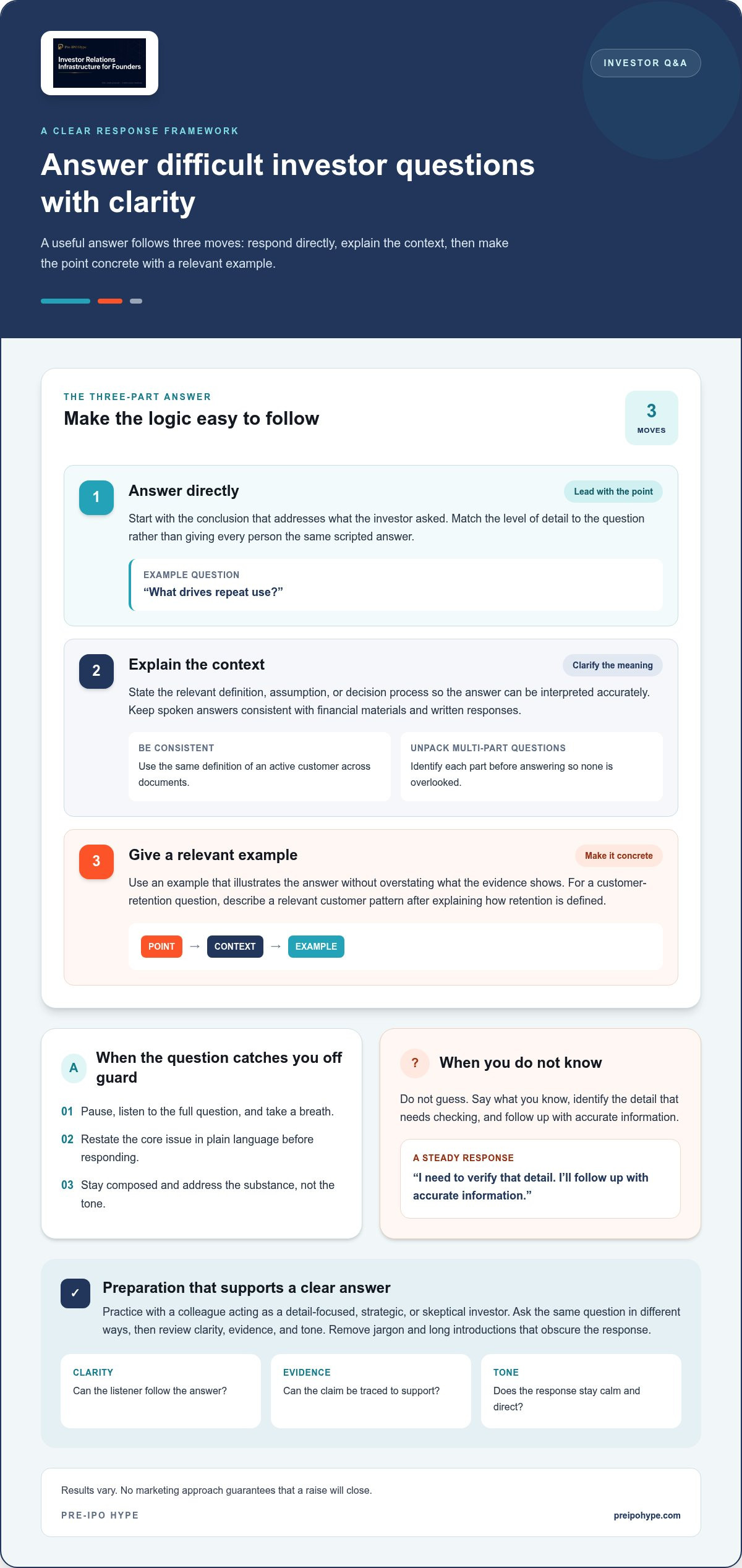
A difficult investor question is an opportunity to show how you think, not a reason to bluff. To understand how to handle difficult investor questions, follow three steps: answer directly, explain the context, and give a relevant example. If you don’t know something, say so and follow up with accurate information.
An investor’s tone can make a tough question feel personal. Stay composed, listen before responding, and address the substance to keep the conversation focused on the business. Learn to adapt your answers to different communication styles, make a credible case for your company, and respond constructively if an investor becomes defensive.
Preparation matters most when a question catches you off guard. Plan for difficult topics, clarify what the investor is asking, and respond honestly when you need time to find the right answer. Results vary, and no marketing approach guarantees that a raise will close.
Key Takeaways
- Match the level of detail to the question, then answer directly, explain the context, and use a relevant example.
- Support your case with evidence such as customer feedback, usage data, pilot results, and industry research.
- If an investor becomes defensive, listen without interrupting and respond to the underlying concern calmly.
- Prepare for difficult topics as well as the ideal pitch, including risks, setbacks, and questions you may not expect.
- If you don’t know an answer, say so plainly and follow up with accurate information.
1. Adapting answers to different communication styles
Investors need different levels of detail. One may want the headline first; another may ask for the assumptions behind a forecast. Adapt the explanation, not the facts. A useful pattern is to answer directly, explain the context, and illustrate the point with an example. For a question about customer retention, state the result, explain how the company defines retention, then describe a relevant customer pattern. This gives investors a clear response without forcing every answer into the same script.
How can you stay calm and confident during challenging investor Q&A? Pause, listen to the full question, and take a breath before responding. Then restate the core issue in plain language, such as, “You’re asking what drives repeat use.” This brief step helps you focus on the investor’s meaning before explaining your answer.
During due diligence, keep spoken answers consistent with financial materials and written responses. Use the same definition of an active customer in every document. If a question has several parts, identify each one before answering. You might say, “I’ll explain the customer segment first, then describe how we test demand.” This makes your reasoning easier to follow and reduces the risk of overlooking part of the question.
Adapt the format to the investor’s style. For someone asking short, analytical questions, lead with the conclusion and its main assumption. For someone focused on strategy, explain the decision process and what the team is testing next. A founder discussing a shift toward sales, for example, could describe which customer signals would support hiring a sales lead. Present these as decision criteria, not proof that a change has already happened.
Practice through role-play before the meeting. Ask a colleague to act as a detail-focused, strategic, and skeptical investor. Have them ask the same question in different ways, then give feedback on clarity, evidence, and tone. Record a practice answer if useful. Remove jargon or long introductions that obscure your response. Rehearsing helps founders adjust their delivery without sounding scripted.
If you don’t know the exact answer, say so rather than guessing. State what you know, identify the detail you need to confirm, and follow up with accurate information. For example, explain that the team is reviewing a customer-segment breakdown and will share the verified figure. For questions about future capital needs, keep the response high-level if the board hasn’t decided to act. Describe the factors under review, such as growth plans and dilution to existing shareholders, without implying a decision or timeline.
2. Demonstrating market opportunity, traction, and competitive advantage
Investors want to know whether a market opportunity connects to a reachable customer base. Build the explanation from the customer outward: identify the buyer, the problem, the alternatives, and the channels that can reach them. For example, a company serving independent clinics can distinguish its target segment from the entire healthcare market. Explain which assumptions support the estimate and how customer discovery or pilot feedback informs them. A clear vision matters, but evidence should show how the business plans to pursue it.
What data and metrics should you bring to investor meetings? Bring current revenue and growth trends, customer retention, acquisition costs, gross margins, and sales pipeline conversion where relevant. Pair each measure with its definition, time period, and source so investors can interpret it consistently.
Choose metrics that connect to your business model. A subscription company might explain recurring revenue alongside retention and customer acquisition cost. A marketplace might show completed transactions, repeat activity, and how supply and demand develop across its segments. Include customer feedback, early usage data, pilot results, and industry research where they support your point. During fundraising, distinguish observed results from forecasts and explain the assumptions behind each projection.
Discuss competitors to demonstrate market understanding, not to criticize them. Name the alternatives customers use, including manual processes or existing tools, and explain where each serves customers well. Then show how your company differs with a specific example: a customer workflow your product addresses, a service need your research identified, or a distribution approach your team is testing. Avoid claiming that no competitor exists. Explain what could make your position defensible, such as customer retention, specialized know-how, or a product that fits an established workflow. Support each claim with evidence you can describe.
Questions about fees, compensation, or investor alignment call for clear, consistent explanations. Describe relevant compensation arrangements and potential conflicts using the same terms as your offering materials. Explain how the company’s incentives relate to its operating plan, rather than suggesting that every investor’s interests are identical. Keep the response factual, and refer legal decisions about offering terms or disclosures to qualified securities counsel.
What should you avoid saying when answering investor questions? Avoid unsupported claims, guarantees, and dismissive remarks about competitors, as each can weaken your response. Instead, acknowledge the concern and point to the evidence, assumption, or risk behind your answer.
For founders learning how to handle difficult investor questions, a useful test is whether a colleague can trace each claim to a metric, customer example, or stated assumption. If they can’t, revise the answer before the meeting. This makes your case more specific without overstating traction or presenting a forecast as a result.
3. What if an investor gets defensive?
A tense moment can shift an investor conversation, but it doesn’t change the facts you need to communicate. If an investor sharply challenges an assumption, don’t interrupt or match their tone. Let them finish, then identify the concern beneath the wording. They may be questioning the evidence, the risk, or how the team made a decision. Respond to that issue rather than defending your character or intentions.
How do you follow up after difficult questions in an investor meeting? Send a concise note that addresses any unanswered point with accurate information and relevant context. If the answer depends on data you needed to confirm, state what you reviewed and clearly correct or complete your response.
A practical framework is to pause, acknowledge, clarify, and respond. A pause gives you room to collect your thoughts. Acknowledging the challenge can be simple: “I understand why that assumption deserves scrutiny.” If the question is broad, ask which part the investor wants to examine first. Then answer with the evidence you have, the limits of that evidence, and the next step the company is taking. For founders, composure means staying focused on the question, not suppressing a legitimate concern.
If an investor vents frustration, let them finish before responding. For example, if they criticize a missed product milestone, acknowledge the delay, explain its cause, and describe the team’s response. Avoid interrupting to correct every detail. If a factual point is wrong, calmly distinguish what happened from what the investor believes happened. This keeps the challenge specific and the conversation productive.
Use a consistent response to rumors about company leaders: decline to comment on rumors, then return to how the leadership team operates. For example, explain how responsibilities are assigned, decisions are made, and company work continues. Don’t speculate about a rumor’s source or discuss an individual’s private matters. Consistency across investor meetings helps prevent conflicting answers from creating confusion.
Close a difficult answer with a concise recap. State the concern, the company’s response, and any follow-up needed. For example: “The launch moved because testing revealed a reliability issue. We’re addressing it before expanding access, and we’ll share the updated test results.” Keep the recap aligned with the evidence and written materials. A confident tone should never imply certainty the facts don’t support.
After the meeting, record the question and the exact point requiring follow-up. Assign an owner, gather the relevant information, and send a direct response through the appropriate channel. This final step creates a clear record of what was asked, what the company knows, and what remains under review.
4. Preparing for unexpected investor questions
Prepare beyond the pitch by mapping questions to decisions, evidence, and responsible team members. Organize a working document around customers, competition, operations, cash needs, risks, and leadership. For each topic, note what the company can answer from current records and what requires further analysis. This helps founders spot information gaps before an investor raises them and keeps preparation grounded in actual company conditions.
What are the most common tough questions investors ask founders? Investors often ask about market size, customer acquisition, revenue, competition, scalability, and risks that could affect the plan. They may also ask how the company would respond if demand slowed, a product milestone slipped, or additional capital became necessary.
Turn each question into a scenario, then record the assumptions that shape the answer. For “What if customer demand weakens?”, identify the indicators the team monitors, the operating choices those indicators could affect, and who would make the decision. Separate what the company observes now from what it might do later. This gives founders a grounded way to discuss uncertainty without presenting a hypothetical as a forecast.
Include questions beyond the usual pitch. An investor might ask how the company would respond to a product failure, a leadership change, or a slower path to acquisition. For each scenario, identify the decision-maker, the information needed, and the next action. If the question is unclear, ask the investor to clarify it. That can prevent a detailed answer to the wrong issue.
Prepare for questions about future capital needs by connecting possible decisions to the operating plan. Map the conditions that could change the plan, such as customer adoption or product development, and explain how the team would assess them. If the board hasn’t decided to raise again, describe the factors under review without implying a decision or timing. Keep answers aligned with company materials, and refer legal decisions about a Regulation CF or Regulation A+ offering to qualified securities counsel.
Practice with a colleague who hasn’t helped draft the answers. Ask them to choose questions from the document and probe the assumptions behind your response. Afterwards, review whether the answer distinguishes current facts from projections and identifies the next step. Add new questions as they arise, then update the relevant response. This turns unexpected questions into a repeatable preparation task and helps the team communicate its reasoning clearly.
Pre-IPO Hype: Custom Investor CRM
Pre-IPO Hype provides investor relations infrastructure for Regulation CF and Regulation A+ raises. We are not a broker-dealer, funding portal, or investment adviser, and we do not offer, sell or recommend securities. This article is educational only and is not legal, tax or investment advice. Pre-IPO Hype fees are never tied to investment results. FWSC and Pre-IPO Hype are paid per form filled out and per meeting booked, with no commission, equity or share of the raise.
For founders preparing a raise, Pre-IPO Hype provides campaign support alongside the issuer's registered intermediary and qualified securities counsel. This support can help coordinate investor communications and campaign activity for an offering.
Our Custom Investor CRM supports lead scoring and attribution tracking.
Contact Pre-IPO Hype to discuss campaign support for your raise.
Make investor communication part of your operating rhythm
Investor conversations can reveal where your company’s story needs greater clarity. Treat recurring questions as useful input: note which assumptions need stronger support, where explanations differ across the team, and what information belongs in future preparation. Over time, this creates a more consistent way to communicate decisions without turning every response into a scripted pitch.
Knowing how to handle difficult investor questions is part of building a credible fundraising process. Keep the discussion grounded in current evidence, and ensure communications for a Regulation CF or Regulation A+ raise align with the issuer’s materials. For legal decisions, work with qualified securities counsel. Campaign support should complement the issuer’s registered intermediary and counsel, not replace their roles.
As you prepare for your next investor conversation, focus on clear answers and disciplined follow-through. Pre-IPO Hype can support your campaign and provide investor relations infrastructure for the process.
Each thoughtful answer helps your team communicate more clearly and confidently.
Frequently Asked Questions
What if an investor gets defensive?
Keep your response focused on the business issue, even if the investor’s tone becomes sharp. For example, if an investor questions a forecast, ask which assumption they want to examine first. Address that point with supporting information, then clarify any disagreement about the underlying data. If the conversation becomes unproductive, suggest returning to the issue after reviewing the relevant materials. A clear boundary can keep the discussion professional without dismissing the concern.
How should you prepare for difficult investor questions?
Prepare a source map alongside your answers. For each key claim, note where the supporting information lives, who owns it, and which definition the team uses. For example, identify the source for reported customer growth and the method used to classify a customer. Ask a colleague to probe the assumptions behind your explanations. This helps reveal gaps between the answer, the underlying evidence, and the materials the team shares.
How do you answer investor questions when you don't know the answer?
Say plainly that you need to confirm the detail, then avoid filling the gap with a guess. Note the exact question and the information needed to answer it. For instance, if asked about a customer segment and you only have company-wide data, explain that distinction rather than implying the figures are equivalent. Follow up with the verified answer through the agreed communication channel, and directly correct any earlier misunderstanding.
How should you respond to questions about weak financial results or missed targets?
Explain the variance between actual results and the plan, then identify the factors behind it. Separate a one-time event from a continuing trend, and show how the team is responding. For example, if sales slipped because a launch moved, clarify the effect on revenue and which operating assumptions need review. Avoid blaming customers or staff. Investors need a clear account of what changed, what the company learned, and what evidence will inform the next decision.
How do you handle investor questions about competition and market size?
Describe the market using a defined customer group and a credible path to reaching it. A bottom-up explanation can connect suitable buyers, their needs, and the channels the company can serve. Discuss competitors as alternatives customers may choose, including existing workflows. Explain where your company differs and what evidence supports that distinction. Avoid calling the business “competition-free”; instead, show how you monitor customer choices and respond as the market changes.
How should founders discuss risks, cash runway, and fundraising needs with investors?
Describe the assumptions behind cash planning and the operating choices that affect runway, such as hiring, sales pace, and product work. Explain which conditions could change the plan and how management would reassess spending. For future fundraising, keep the discussion focused on factors under review if the board hasn’t decided to act. Align communications with company materials, and refer legal decisions about a Regulation CF or Regulation A+ offering to qualified securities counsel.
Disclaimer
Educational only. Not investment, tax, or legal advice. Pre-IPO Hype is investor relations infrastructure for Regulation CF and Regulation A+ raises. We are not a broker-dealer, funding portal, or investment adviser, and we do not offer or sell securities or make investment recommendations. Any securities offering is made only by the issuer, through its own offering documents and, where required, a registered intermediary.


