
Equity Crowdfunding Marketing Strategy: A Founder's Plan
What does an equity crowdfunding marketing strategy need beyond a launch post and a few ads? Founders preparing a Regulation CF or Regulation A+ raise need a plan that ties every channel to the offering, sets one review path for messages and sends people to the issuer’s registered intermediary or offering page for offering information. Earned media, especially investment newsletters that fit your audience, is one of the most credible parts of that plan, and one of the easiest to get wrong.
This guide outlines an equity crowdfunding marketing strategy built on owned, earned and paid channels, then goes deep on earned coverage: building a focused newsletter list, shaping a concise, evidence-led pitch and planning outreach without assuming coverage is assured. A paid placement, where the issuer pays the publisher, is advertising, not independent editorial coverage. For Regulation Crowdfunding promotion on an intermediary’s platform, anyone the issuer pays to promote the offering must disclose that compensation each time, as required by Rule 205. Send legal decisions to qualified securities counsel. Results vary. No marketing approach guarantees that a raise will close.
Key Takeaways
- Build your equity crowdfunding marketing strategy around the offering, with owned, earned and paid channels that all point to the offering page.
- Use earned coverage, such as investment newsletters, by pitching one relevant story backed by verifiable facts.
- Separate verifiable facts from forecasts, opinions and promotional language before sharing company materials.
- Compare earned coverage and paid promotion by payment, disclosure, editorial control and message control.
- Organize outreach for the issuer with approved materials and clear records, alongside the registered intermediary and qualified securities counsel.
Build Your Equity Crowdfunding Marketing Strategy Around the Offering
An equity crowdfunding marketing strategy is a plan for how the issuer will tell people about its raise, through which channels, with which approved messages and under whose review. Start by confirming with the registered intermediary and qualified securities counsel what can be communicated at each stage of the offering. Then decide which channels can carry those messages consistently.
| Channel type | Examples | Who controls the message |
|---|---|---|
| Owned | Email list, website, blog, company social accounts | The issuer, through its review process. For Regulation CF, communications outside the intermediary platform are limited to tombstone style notice content under Rule 204, with a link to the offering page. |
| Earned | Investment newsletters, press, podcasts | The publisher or editor |
| Paid | Ads, sponsored newsletter placements, paid promoters | Shared; must be labeled as paid, and Regulation CF paid promoters disclose compensation under Rule 205 |
Set goals, owners and review before choosing tactics
Define operational goals, such as reaching existing customers and supporters with accurate information, rather than funding targets you cannot control. Assign an owner to each channel, set one review path, and keep a record of what was sent and where. Measure activity to learn what is working operationally, without treating opens, clicks or replies as evidence of investment intent.
Why earned coverage deserves its own plan
Owned channels reach people who already know the company. Earned coverage can introduce the company to new readers through an independent voice, but only if the story fits the publication. The sections below show how to approach investment newsletters as the earned-media part of your equity crowdfunding marketing strategy.
What Does It Mean to Be Featured in an Investment Newsletter?
A feature is editorial attention from a newsletter that is independent of the company being discussed. It might be a brief company mention, a quote from a founder, or a broader story about a sector that includes the company as one example. The format and depth depend on the publication and its editorial judgment.
Founders can make a story more relevant by connecting it to the publication’s subject matter and supporting claims with evidence. They can’t control whether an editor covers it, how the story is framed, or when it appears. When considering how to earn investment newsletter coverage, focus on presenting a relevant, supportable story, not securing a guaranteed outcome.
Earned editorial coverage: An editor independently decides whether and how to cover a company or topic. The issuer doesn’t buy the editorial decision.
Paid promotion: The issuer pays the newsletter publisher for a promotional opportunity, which should be clearly identified as paid. It isn’t independent editorial endorsement.
How Investment Newsletters Differ in Audience and Editorial Focus
A finance label alone says little about fit. Market commentary may focus on broad economic developments, while sector analysis examines a particular industry. Deal coverage may report on transactions or company financing activity. Company-focused newsletters may concentrate on updates about one issuer. Each format serves a different reader interest and offers different room for a company story.
Review the publication’s topics, intended reader, and format before deciding it belongs on an outreach list. Lyn Alden’s newsletter overview is one example of a publication describing a defined investment focus. A founder can use that kind of description to assess whether company news is relevant to the outlet, rather than relying on a general finance category.
Earned Coverage, Paid Placement, and Issuer Communications
Earned coverage is an editorial choice. A founder can provide information or suggest a story, but the editor decides whether to use it and what to publish. A paid placement is a promotional arrangement in which the issuer pays the publisher, not an editorial feature. The paid nature should be clearly identified to readers. If a publication offers sponsored content, clarify what the arrangement covers, including who controls the wording and how the content will be labeled.
An issuer’s own newsletter is different from both. It is a company communication distributed through the issuer’s channels, not third-party coverage. These options serve distinct communication purposes and shouldn’t be presented as interchangeable. Keep records that distinguish editorial outreach, paid promotion, and issuer updates. For founders preparing a Regulation CF or Regulation A+ raise, send legal and compliance questions about communications to qualified securities counsel.
How to Find Investment Newsletters That Fit Your Company
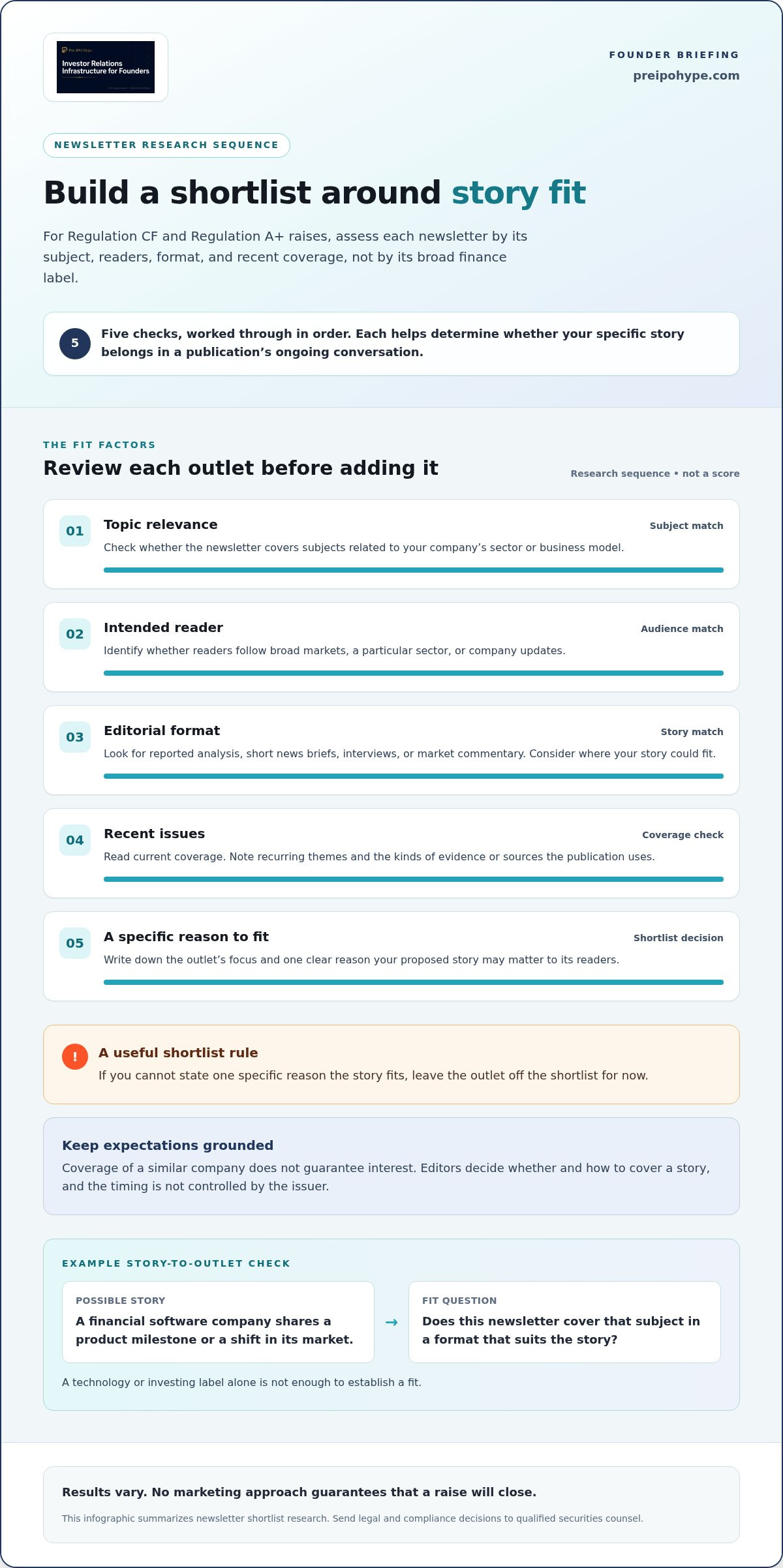
A useful shortlist starts with the story you can support, not a search for the biggest finance publication. To assess how to earn investment newsletter coverage, examine each outlet’s subject matter, intended reader, format, and recent coverage. A newsletter’s broad investment label is only a starting point. Fit depends on whether your specific company news or insight belongs in its ongoing conversation.
Build a Shortlist Around Story Fit
Begin with the company’s sector and business model, then identify the news or insight you can discuss with evidence. A company developing financial software—such as an AI platform like tickerai.ai that focuses on stock opportunity discovery—may have a story about a product milestone or a shift in its market. That does not automatically make it suitable for every publication covering technology or investing. Look for a clear editorial connection.
Use this research sequence for each candidate:
- Check topic relevance. Note the subjects the newsletter covers and whether they overlap with the company’s sector or business model.
- Identify the intended reader. Is the publication written for investors following broad markets, readers focused on a specific sector, or an audience seeking company updates?
- Review the format. Recent issues may feature reported analysis, short news briefs, interviews, or market commentary. Consider whether your story could fit that format.
- Read recent issues. Review current coverage before adding the outlet to your outreach list. Look for recurring themes and the kinds of evidence or sources used.
- Write down the fit. Record the outlet’s editorial focus and one specific reason your proposed story may be relevant. If you can’t state that reason clearly, leave the outlet off the shortlist for now.
Compare your proposed story with themes the publication has covered, rather than assuming that a past article about a similar company guarantees interest. If an outlet focuses on market volatility strategies or risk mitigation tools like Alpha Shield to navigate drawdowns, a standard fundraising update will not fit. Exclude outlets where the subject or presentation would require stretching the story.
Check Editorial Routes and Paid Options Separately
Look for public instructions on submitting editorial ideas, contacting writers, or sharing company information. Record those directions separately from advertising or sponsorship details. A public advertising page describes a promotional route, not an invitation to editorial coverage. Note whether each possible route is an editorial pitch, sponsored placement, or another form of promotion, and don’t treat them as interchangeable.
For a Regulation CF or Regulation A+ raise, keep the publication research and outreach records organized for the issuer. A simple tracker can capture the outlet, its focus, recent examples, the proposed story angle, the appropriate contact route, and any response. Outreach and campaign activities are conducted for the issuer alongside its registered intermediary and qualified securities counsel. Campaign planning can include organizing this work.
How to Prepare a Clear, Evidence-Led Newsletter Pitch
A pitch should make it easy for an editor to assess the story, its relevance to the publication, and the evidence behind it. Keep the message focused on one angle rather than trying to summarize the company, its raise, and its future plans all at once. The aim when learning how to earn investment newsletter coverage is to present a credible story for consideration, not to imply that coverage is assured.
Frame a Story an Editor Can Assess
Lead with a specific angle connected to the outlet’s demonstrated editorial focus. Explain why the subject may be relevant to that publication’s coverage without claiming to know what its readers think or want. Keep company background brief, then distinguish established facts from forecasts, opinions, and statements about future plans. Make clear what is verifiable and what is interpretation.
Use a direct subject line that names the topic, not a claim designed to create urgency. For example: “Company update on [specific sector development]” is clearer than “A major opportunity you can’t miss.” The first tells the recipient what the message concerns; the second makes an unsupported promotional appeal.
A concise pitch can follow this structure:
- Story: State the specific development, question, or insight you’re proposing.
- Outlet fit: Identify a relevant theme or format from the publication’s recent coverage.
- Evidence: Summarize the support for the central claim, with sources where appropriate.
- Next step: Offer to provide relevant source material or make an appropriate company spokesperson available.
For example, a company announcement may be less useful than a clearly supported explanation of how a market change affects the company’s sector. Keep the proposed angle proportionate to the available facts. Don’t present forecasts as results or describe interest, demand, or momentum unless the issuer can substantiate the statement.
Support the Pitch and Follow Up Professionally
Before sending, check every factual claim against material the issuer can support. If you include a statistic, identify its source and make sure it supports the point being made. Separate reported figures from management estimates, opinions, and projections. For Regulation CF or Regulation A+ communications, have qualified securities counsel review legal questions and materials that raise compliance concerns.
Include a relevant contact who can respond to editorial questions. Attach or offer only useful supporting material, such as a public company announcement or source document, and avoid overwhelming the editor with a large package. Make it clear that additional material is available on request.
If there’s no reply, one concise, courteous follow-up can confirm that the original pitch reached the right person. Add no new unsupported claims and don’t imply that a response or feature is expected. If the editor declines or remains silent, respect that decision and reassess whether the story or outlet is a suitable fit. Editors control their coverage, and a well-prepared pitch remains a proposal for consideration.
How to Compare Earned Newsletter Coverage With Paid Promotion
Earned editorial coverage and paid promotion are different routes, with different levels of control and expectations. For founders considering how to earn investment newsletter coverage, the key question is whether the format, audience, labeling, and editorial independence fit the issuer’s communication goals.
What Earned Editorial Outreach Can and Cannot Control
An issuer can choose a story angle, prepare supporting information, and decide which editors to approach. The editor decides whether to publish, what to include, and how to frame the story. An editorial mention isn’t a paid commitment, a guaranteed placement, or a signal that the editor endorses the company or considers it a suitable investment.
That separation means the issuer doesn’t control the final editorial treatment. Keep expectations clear internally: outreach invites consideration. It doesn’t purchase an editorial decision or establish investment merit.
What to Assess Before Using a Paid Placement
With a paid placement, the issuer pays the newsletter publisher for a promotional opportunity. Clarify how the publication will identify the content as paid, what format it will use, and how much input the issuer has over the message. A paid placement is promotion, not independent editorial endorsement, so don’t compare it with earned coverage as if the two were interchangeable.
Use this comparison to assess the options:
Editorial control: Earned coverage is selected and shaped by the editor. For paid promotion, the publisher defines the available format and the agreement describes the issuer’s role in the content.
Payment: Earned editorial outreach doesn’t mean the issuer has purchased coverage. For a paid placement, the issuer pays the publisher.
Disclosure: Paid promotion should be identifiable to readers. For Regulation Crowdfunding promotion on an intermediary’s platform, anyone the issuer pays to promote the offering must disclose that compensation each time, as required by Rule 205.
Message control: Editorial coverage may be framed or edited by the publication. A paid arrangement may offer more input, depending on the publisher’s terms.
Suitability: Consider whether the publication’s subject, readership, and format fit the issuer’s story. Avoid relying on unsupported estimates of reach or performance.
Before agreeing to paid promotion, document who pays whom, how the placement is labeled, what content is included, and where it appears. Send legal questions about Regulation CF communications and compensation disclosures to qualified securities counsel.
Campaign workflows can be discussed alongside the issuer’s registered intermediary and qualified securities counsel through a fundraising workflow conversation.
How to Organize Newsletter Outreach for a Regulation CF or Regulation A+ Raise
Newsletter outreach works best as part of a coordinated issuer communications process. Before contacting publications, align the proposed story with materials approved for use, confirm who can respond to questions, and agree on how replies and follow-up will be handled. This helps keep the issuer’s public statements consistent across editorial outreach and other campaign activity.
Keep the Issuer’s Outreach Organized
Use one shared workflow for research, pitch versions, and correspondence conducted for the issuer. A consistent record helps the team see what was sent, to whom, and what needs attention next. Useful fields include:
- Publication and contact route: Record the outlet and its stated editorial or advertising submission process.
- Editorial fit: Note the relevant subject matter and the reason the proposed story may fit.
- Pitch version and materials: Keep the sent pitch and the supporting issuer-approved information together.
- Response and next action: Log replies, requests for more information, declines, and any appropriate follow-up.
Keep editorial pitches distinct from paid promotion records and issuer communications. That separation makes it easier to understand the status and nature of each interaction. Our Custom Investor CRM supports lead scoring and attribution tracking. The fundraising technology stack guidance provides context for how outreach records fit alongside other issuer campaign systems.
Agree in advance who reviews materials, who sends outreach, and who handles editorial questions. For a Regulation CF or Regulation A+ raise, campaign activities and outreach are conducted for the issuer alongside its registered intermediary and qualified securities counsel. Send legal and compliance decisions to qualified securities counsel.
Where Pre-IPO Hype Fits in Campaign Support
Operational support can help the issuer coordinate publication research, approved materials, and outreach records. It does not determine whether a publication will cover the company. The newsletter outreach information discusses this work as campaign support. A workflow conversation can focus on how these activities are organized for the issuer, without implying newsletter access or placement.
Campaign activities can be organized for the issuer alongside its registered intermediary and qualified securities counsel through a workflow conversation.
Make Earned Coverage Part of Your Equity Crowdfunding Marketing Strategy
Newsletter outreach can be treated as a continuing editorial practice, not a one-time announcement. As your company develops, new milestones or industry changes may create different story angles. Keep a record of what you learn from each interaction, then use that information to make future pitches more relevant and precise. A decline or a lack of response is not a verdict on the company. It may simply mean the timing, angle, or publication wasn’t a fit.
For founders building an equity crowdfunding marketing strategy while preparing a Regulation CF or Regulation A+ raise, decide how this work fits into the issuer’s broader communications workflow. Set clear review responsibilities and keep outreach aligned with the materials approved for use. Legal decisions belong with qualified securities counsel.
Pre-IPO Hype is investor relations infrastructure for Regulation CF and Regulation A+ raises. We are not a broker-dealer, funding portal, or investment adviser, and we do not offer, sell or recommend securities. This article is educational only and is not legal or investment advice. Pre-IPO Hype fees are never tied to investment results.
For help planning how newsletter research and outreach fit into your workflow, schedule a fundraising workflow conversation.
Frequently Asked Questions
What is an equity crowdfunding marketing strategy?
It is the issuer’s plan for communicating about its Regulation CF or Regulation A+ raise: which owned, earned and paid channels to use, which approved messages they carry, who reviews them, and where people go for offering information. Results vary, and no marketing approach guarantees that a raise will close.
How do you get a company featured in an investment newsletter?
To make an editorial pitch relevant, identify a story that fits the publication’s coverage and can be supported with reliable information. The practical work in learning how to earn investment newsletter coverage is selecting suitable outlets and making the relevance clear to each editor. For example, connect a company development to a subject the newsletter has covered, and make a knowledgeable spokesperson available for follow-up questions.
Can a company pay to be featured in an investment newsletter?
Yes, a company may pay a newsletter publisher for a promotional placement if the publisher offers that option. The issuer pays the publisher, and the content should be identified as paid promotion rather than presented as independent editorial coverage. Before agreeing, clarify the format, labeling, publication schedule, and what input the issuer has over the message. Payment is for a promotional opportunity, not an editorial endorsement or a specific response from readers.
What should a founder include in a newsletter pitch?
A founder should include a clear subject line, the proposed story, why it may suit the outlet, and a way to verify the key facts. Keep background information brief. Label forecasts and opinions so they aren’t mistaken for established facts, and avoid unsupported claims about future performance. Close by offering a relevant source document or spokesperson. Share only materials approved for the issuer’s communications, especially when they relate to a Regulation CF or Regulation A+ raise.
How do you find investment newsletters relevant to your company?
Start with the company’s sector and the specific topic it can discuss, then look for newsletters that cover that subject for a relevant readership. Read recent issues, not just the publication’s description. For example, a company with an industry update may be a better fit for a sector-analysis newsletter than one focused mainly on general market commentary. Record the reason for each potential fit and remove outlets where the story would feel out of place.
Does a newsletter feature guarantee investor interest or funding?
No. A newsletter mention does not guarantee that readers will notice the company, take interest, or invest. Editorial coverage reflects a publication’s decision to cover a story; it doesn’t assess whether an offering is suitable for any particular person. Founders should avoid treating coverage as evidence of demand or as a forecast of fundraising results. For investment or legal questions about an offering, consult qualified securities counsel and direct investors to the issuer’s registered intermediary or offering page.
What disclosure applies when someone is paid to promote a Regulation Crowdfunding offering?
Anyone the issuer pays to promote the offering on the platform must disclose that compensation each time. This disclosure requirement is under SEC Rule 205. It applies to paid promotion through the intermediary’s platform, so the issuer should account for compensation disclosures in each relevant communication. Ask qualified securities counsel how the rule applies to a specific promotional arrangement. This answer is general information, not legal advice.
How should a founder follow up after pitching a newsletter editor?
If the editor hasn’t replied, send one brief, courteous follow-up that refers to the original message and asks whether the proposal is relevant. Avoid adding new claims just to prompt a response. If the editor declines or doesn’t respond again, respect that signal and move on rather than sending repeated messages. Update the outreach record with the result and use it to guide future decisions about whether the outlet remains a sensible fit.
Disclaimer
Educational only. Not investment, tax, or legal advice. Pre-IPO Hype is investor relations infrastructure for Regulation CF and Regulation A+ raises. We are not a broker-dealer, funding portal, or investment adviser, and we do not offer or sell securities or make investment recommendations. Any securities offering is made only by the issuer, through its own offering documents and, where required, a registered intermediary.


