
Common Equity Crowdfunding Mistakes Founders Make
Preparation matters as much as the live campaign. Common equity crowdfunding mistakes often begin before launch, when founders treat marketing as an afterthought or underestimate the work of keeping investors informed. In the United States, a Regulation Crowdfunding offering must run through one SEC-registered broker-dealer or funding portal, according to the U.S. Securities and Exchange Commission.
It’s understandable to focus first on reaching a fundraising goal. But a campaign also needs a clear company story, thoughtful marketing, and a plan for communicating with investors after they commit. Strong preparation helps founders set realistic expectations and keep their messaging consistent.
This article explains seven common equity crowdfunding mistakes founders make and how to prepare before a campaign goes live. You’ll learn how to build campaign marketing around your company’s story, understand reporting obligations, and communicate with investors when business updates matter. Results vary, and no marketing approach guarantees that a raise will close.
Key Takeaways
- Build your campaign story and marketing plan before launch, then keep the message consistent across channels.
- Plan for ongoing reporting and investor updates, including clear communication when material business changes occur.
- Understand how Regulation Crowdfunding works, including its offering limit and the role of a registered intermediary.
- Use organized investor communications to track questions and keep campaign information accurate and timely.
- Follow the Regulation CF rules on when and how an offering can be promoted, and make sure paid promoters disclose their compensation.
1. Launching with no pre-launch audience or message
A common first mistake is reaching launch day without an audience or a message ready. Launch day is too late to decide what your company wants to say. Before starting a Regulation CF campaign, prepare the core message, audience plan, and content. Use the prelaunch period to develop the company’s story, not just count down to a fundraising announcement. A clear foundation helps keep the product, business model, and offering message consistent.
Start with the customer problem. Describe who experiences it, how your product addresses it, and what evidence supports your explanation. For example, a founder selling a food-waste tracking tool could show how a restaurant uses it in daily operations. Keep the example accurate and tied to the product customers can actually use. Avoid broad claims your business cannot support.
Next, map the story across the channels you plan to use. A campaign page, founder email, social post, and video should each explain the same company and offering. Their formats may differ, but the facts should not. Draft key messages before publishing, then check that product descriptions, business updates, and offering information remain aligned.
A founder video can make the company story easier to follow. Use it to introduce the team, explain the customer problem, and demonstrate the product where practical. Keep the script focused on what viewers can understand and verify. If the video mentions the offering, coordinate its content with the issuer’s registered intermediary and qualified securities counsel.
Build communication with existing customers into the plan. They may value product updates, support, and clear explanations independently of an investment campaign. For example, a software company can separate routine product notices from offering communications so customers know which message they’re receiving. Don’t assume that customer interest in the product automatically means interest in investing.
Choose distribution channels for fit, not novelty. A specialist community may understand a technical product better than a broad audience, while an unconventional channel may suit a niche customer group. Decide what each channel is meant to communicate, and give readers a clear route to the issuer’s offering page or registered intermediary. Avoid unsupported claims about demand or campaign progress.
Also prepare answers to likely questions about the company, product, and use of proceeds. A thoughtful prelaunch plan makes campaign marketing more coherent and gives founders a practical basis for responding consistently.
2. Marketing before Form C is filed or outside the advertising rules
An issuer must file Form C with the SEC before the offering begins, and provide it to investors and the relevant intermediary, unless the solicitation-of-interest rule applies, according to 17 CFR 227.203 (a)(1). An issuer, including persons acting on its behalf, may not directly or indirectly advertise the terms of a Regulation CF offering, except through a limited notice or a communication that meets the solicitation-of-interest rule, according to 17 CFR 227.204 (a). The rule defines the terms of the offering to include the amount, nature and price of the securities, the closing date, the planned use of proceeds, and the issuer’s progress toward its funding target, according to 17 CFR 227.204 (e). A permitted notice must direct investors to the intermediary’s platform and may include only the limited information the rule lists, according to 17 CFR 227.204 (b).
Before an offering statement is filed, an issuer may communicate to determine whether there is interest in a contemplated offering, according to 17 CFR 227.206 (a). Those communications must state that no money or other consideration is being solicited, that no offer to buy can be accepted until the offering statement is filed and only through an intermediary’s platform, and that indicating interest creates no obligation or commitment, according to 17 CFR 227.206 (b). They are treated as offers for purposes of the antifraud provisions of the federal securities laws, and no money or commitment may be solicited or accepted until the offering statement is filed, according to 17 CFR 227.206 (a).
Issuers and persons acting on their behalf may discuss offering terms through the communication channels the intermediary provides on its platform, as long as they identify themselves and their affiliation with the issuer, according to 17 CFR 227.204 (c). Before publishing campaign promotion on a Regulation Crowdfunding platform, review the communication process with qualified securities counsel.
3. Misunderstanding investor limits and offering basics
Regulation Crowdfunding, often called Regulation CF, allows eligible companies to offer securities to the public through a registered intermediary. Investors receive securities, not product rewards, and may lose their investment. The offering materials explain the company, security, and risks. Founders should treat those documents as core campaign materials, not as an administrative step after marketing begins.
In the United States, a Regulation Crowdfunding issuer may raise up to $5 million during a 12-month period, according to the U.S. Securities and Exchange Commission. A Reg CF offering must run through one SEC-registered broker-dealer or funding portal, according to the U.S. Securities and Exchange Commission.
For a non-accredited Reg CF investor whose annual income or net worth is below $124,000, the U.S. Securities and Exchange Commission permits investment of the greater of $2,500 or 5% of the greater of income or net worth across Reg CF offerings in a rolling 12-month period. If both annual income and net worth are at least $124,000, the limit is 10% of the greater of the two, capped at $124,000. The SEC adjusts these figures for inflation at least every five years, so check the current amounts on Investor.gov. The calculation applies across offerings, not solely to one issuer. Founders should understand these limits, because they affect how much an individual investor may commit across offerings.
A Reg CF investor can generally cancel a commitment until 48 hours before the offering deadline, according to the U.S. Securities and Exchange Commission. Founders should communicate campaign progress accurately and avoid treating a cancellable commitment as final. This distinction matters when describing progress to the public or making business plans based on expected proceeds.
Choose a platform that serves your company’s business niche and can administer a Regulation CF offering. Compare issuer eligibility, platform processes, investor-facing materials, and how questions are handled. Confirm that the offering runs through the required registered intermediary, rather than choosing a platform based only on its reach or interface.
Regulation CF and Regulation A+ differ in eligibility, disclosure requirements, and offering structure. The appropriate route depends on the issuer’s circumstances and fundraising plan. Discuss those factors with qualified securities counsel before selecting an exemption. Each pathway has distinct requirements, so founders should not assume a campaign process transfers unchanged between them.
For a U.S. Regulation CF offering, the SEC framework includes issuer disclosures, intermediary requirements, and investor limits. Founders should work with qualified securities counsel on eligibility, filings, and disclosure decisions. Investors should read the offering documents and understand the specific security before committing.
State requirements and issuer location can affect the analysis, particularly for companies based outside the United States. The applicable rules depend on the issuer’s structure and offering circumstances. Qualified securities counsel can assess those details before the company chooses its fundraising route or begins soliciting investors.
Equity crowdfunding carries risks of loss, dilution, and illiquidity. Future financings may reduce an investor’s ownership percentage, while company failure can result in losing the investment. Reg CF securities generally cannot be resold for one year, subject to limited exceptions, according to the U.S. Securities and Exchange Commission. Investors should consider these risks before investing.
4. Ignoring promoter compensation disclosure
Under Rule 205, anyone the issuer pays to promote the offering on the platform must disclose that compensation each time. The rule permits an issuer to pay someone to promote an offering through an intermediary’s communication channels, but only if the issuer takes reasonable steps to ensure the promoter clearly discloses the compensation with each communication, according to 17 CFR 227.205 (a).
That disclosure applies whether or not the compensation is specifically for promotional activities, and it covers people who are otherwise employed by the issuer, according to the instruction to 17 CFR 227.205 (a). Outside those platform channels, paying someone to promote the offering is limited to notices that comply with the advertising rule, according to 17 CFR 227.205 (b). Ask qualified securities counsel to review any paid promotion arrangement before it begins.
5. Skipping ongoing reporting and Form C-AR
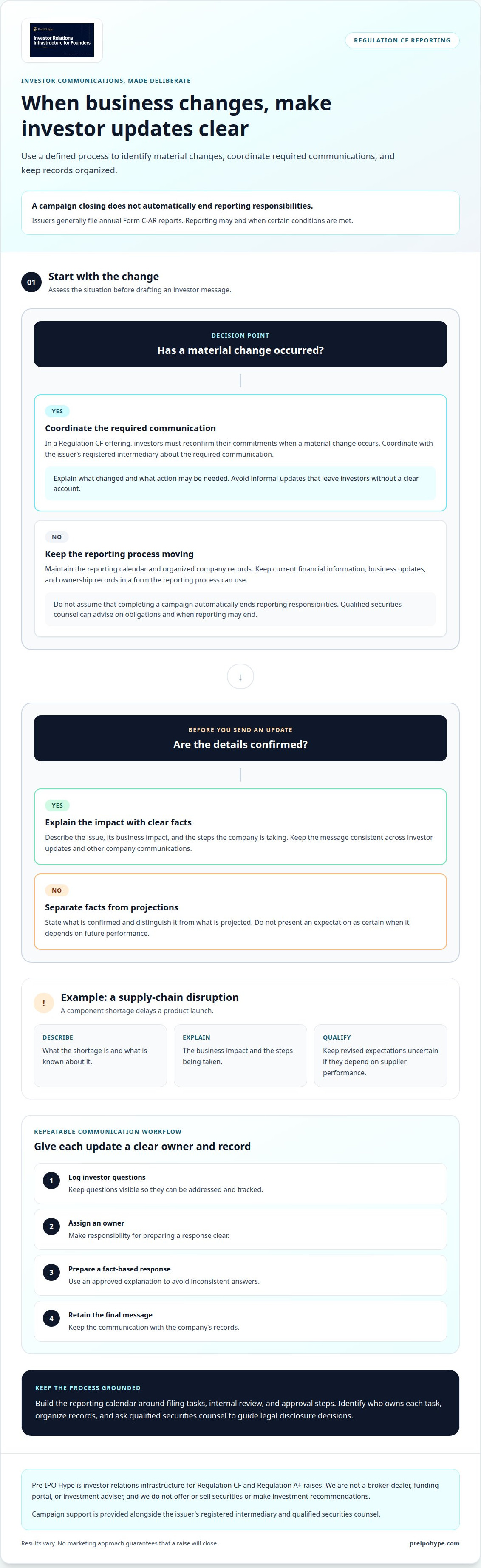
A Regulation CF campaign doesn’t end when the offering closes. Issuers generally file annual Form C-AR reports, and reporting may end when certain conditions are met. Plan for these filings early, assign responsibility, and keep company records organized. For example, maintain current financial information, business updates, and ownership records in a form the reporting process can use.
An issuer that has sold securities under Regulation CF must file an annual report on Form C-AR with the SEC no later than 120 days after the end of the fiscal year covered, according to 17 CFR 227.203 (b)(1). The issuer must also post the annual report on its website, according to 17 CFR 227.202 (a). The report includes the issuer’s financial statements, and if those statements have not been reviewed or audited by an independent public accountant, the principal executive officer must certify that they are true and complete in all material respects, according to 17 CFR 227.202 (a). Reporting continues until a condition in the rule is met, such as the issuer becoming subject to Exchange Act reporting, all of the securities being repurchased, or the issuer liquidating or dissolving, according to 17 CFR 227.202 (b). An issuer that becomes eligible to stop reporting must file Form C-TR within five business days, according to 17 CFR 227.203 (b)(3).
Build a reporting calendar around the issuer’s obligations. Track filing tasks, internal review, and approval steps, then identify who owns each task. A missed handoff can delay preparation or leave important details unresolved. Qualified securities counsel can advise on legal obligations and when reporting may end. Don’t assume that completing a campaign automatically ends the issuer’s reporting responsibilities.
6. Mishandling material changes
In a Regulation CF offering, investors must reconfirm their commitments when a material change occurs. If the company changes a major business plan or faces a significant operational issue, coordinate with the registered intermediary about the required communication. Avoid informal updates that leave investors without a clear explanation of what changed and what action may be needed. Before an offering is completed or terminated, an issuer must file an amendment on Form C/A to disclose material changes, additions or updates to the information it provides to investors through the intermediary’s platform, according to 17 CFR 227.203 (a)(2).
When the amendment reflects material changes, the issuer checks the box indicating that investors must reconfirm within five business days or their commitment is considered cancelled, according to 17 CFR 227.203 (a)(2). If a previously filed annual report needs a material change, the issuer must file an amendment on Form C-AR/A as soon as practicable after discovering the need, according to 17 CFR 227.203 (b)(2).
Supply-chain problems show why timely updates matter. If a component shortage delays a product launch, explain the issue, its business impact, and the steps the company is taking. Separate confirmed facts from projections. Don’t present a revised delivery expectation as certain when it depends on a supplier’s future performance. Keep the message consistent across investor updates and other company communications.
An issuer must also file progress updates on Form C-U, including a final update within five business days after the offering deadline, according to 17 CFR 227.203 (a)(3).
7. Sending weak investor updates
Investor communications need their own process. Use a repeatable communication workflow. Log investor questions, assign an owner, prepare a fact-based response, and retain the final message with the company’s records. For example, if investors ask about a manufacturing delay, the team can use one approved explanation rather than give inconsistent answers in separate conversations. Set realistic expectations about product availability and company milestones. Don’t promise more than the business can deliver. Use deadlines, caps, and perks only when they are real and disclosed in your offering documents. A documented process helps founders handle reporting and investor communications consistently as the company’s circumstances change.
Some investors may also be customers, making sensitive business information harder to compartmentalize. Before sending an update, consider whether customers who invested could also read it. That doesn’t justify withholding required information. Instead, prepare accurate explanations that protect confidential details where appropriate and give investors a clear account of material developments. Ask qualified securities counsel to guide legal disclosure decisions.
Prepare clear answers to the questions investors ask most often, and route offering questions to the intermediary's platform.
Pre-IPO Hype: Custom Investor CRM
Pre-IPO Hype provides investor relations infrastructure for Regulation CF and Regulation A+ raises. We are not a broker-dealer, funding portal, or investment adviser, and we do not offer or sell securities or make investment recommendations. Pre-IPO Hype fees are never tied to investment results. FWSC and Pre-IPO Hype are paid per form filled out and per meeting booked, with no commission, equity or share of the raise. This article is educational only and is not legal, tax or investment advice.
Founders planning campaign marketing or investor communications can use our support alongside the issuer’s registered intermediary and qualified securities counsel. Our infrastructure helps organize campaign materials and issuer communications, while legal decisions remain with qualified securities counsel.
Our Custom Investor CRM supports lead scoring and attribution tracking. Investor Relations and Marketing Campaigns support marketing planning for the issuer. The issuer and its registered intermediary control all offering communications.
Contact Pre-IPO Hype to discuss campaign support for a Regulation CF or Regulation A+ raise.
Turn campaign preparation into a clear next step
Treat common equity crowdfunding mistakes as prompts to examine your decision-making, not as a reason to rush. Before moving forward, turn the lessons into a practical readiness plan: identify who owns campaign communications, how approvals will work, and which questions need qualified securities counsel. A written plan gives your team a shared reference point as priorities shift.
Use that plan to decide what needs attention first. If your message is still changing, focus on clarity before expanding outreach. If investor updates lack an owner, assign responsibility before the campaign generates more questions. If legal or offering details are unresolved, bring those decisions to qualified securities counsel. The next step should match the actual gap, not a generic launch checklist.
Equity crowdfunding asks a company to communicate carefully while building a long-term relationship with investors. Thoughtful preparation can help your team approach that responsibility with a steadier process. Take the time to make the next decision deliberate, and move forward with a plan your team can follow.
A clear process is a strong place to begin.
Frequently Asked Questions
What are the common equity crowdfunding mistakes founders make?
Common equity crowdfunding mistakes include launching without a pre-launch audience or message, marketing outside the Regulation CF advertising rules, misunderstanding investor limits, ignoring promoter compensation disclosure, skipping annual Form C-AR reporting, mishandling material changes, and sending weak investor updates. A practical fix is to keep one approved set of current descriptions, documents, and answers for the team. For example, if a product feature changes, update the relevant materials together rather than changing only a social post. Assign someone to review updates before they are shared.
What steps should a startup take to prepare and market an equity crowdfunding campaign?
Start with an internal readiness review. Confirm that the product description, company details, offering materials, and investor-facing answers use consistent information. Test the campaign page on mobile and desktop, verify that its documents open, and rehearse how the team will handle questions it cannot answer immediately. Then coordinate marketing materials with the issuer’s registered intermediary and qualified securities counsel before publishing offering-related communications.
What happens if a company misses deadlines or makes errors in its crowdfunding disclosures?
A missed deadline or inaccurate disclosure can leave campaign information incomplete or inconsistent, creating confusion for investors and compliance concerns for the issuer. Preserve the affected materials and note where they appeared. Then promptly raise the issue with the registered intermediary and qualified securities counsel. They can assess the facts, advise on any correction, and guide investor communications. Avoid silently replacing a document without addressing the inaccurate version.
Disclaimer
Educational only. Not investment, tax, or legal advice. Pre-IPO Hype is investor relations infrastructure for Regulation CF and Regulation A+ raises. We are not a broker-dealer, funding portal, or investment adviser, and we do not offer or sell securities or make investment recommendations. Any securities offering is made only by the issuer, through its own offering documents and, where required, a registered intermediary.